

The New Tax Rate
At Great Barrington’s Tuesday night’s joint Finance Committee and Selectboard meeting, the Select Board voted for a single tax rate of $12.87 per $1,000, down 37 cents from last year. The total assessed property value, both residential and commercial, is $2.4 billion, with residential representing 83%. New growth added $26.8 million in value, or about $356,000 in levy.
The bit of good news on the tax rate front was swiftly overshadowed by bad news on the overall state of the town’s budget. The budget gap between expenses and revenue is about $6,794,000, up from about $5.5 million last year, and the town manager predicts that number will grow to about $8.7 million in fiscal year 2028 if nothing changes.
It’s a good time, then, to consider what revenue might be collected in the form of updated property assessments.
A conversation about Simon’s Rock started Great Barrington’s push for new revenue
Town officials had started considering new revenue well before Tuesday’s meeting, with one step in the revenue-generating direction indirectly taken at Town Meeting last spring.
That’s when voters approved $43,000 to pay for much-needed assessment software upgrades to assist the assessor in streamlining the town’s outdated system — whose current software programs don’t communicate smoothly with each other — and bringing property cards into line with accurate real estate sales data. Assessor Emily Schilling confirmed on Tuesday that the new software has not been implemented yet, since “conversions can take months to finish.”
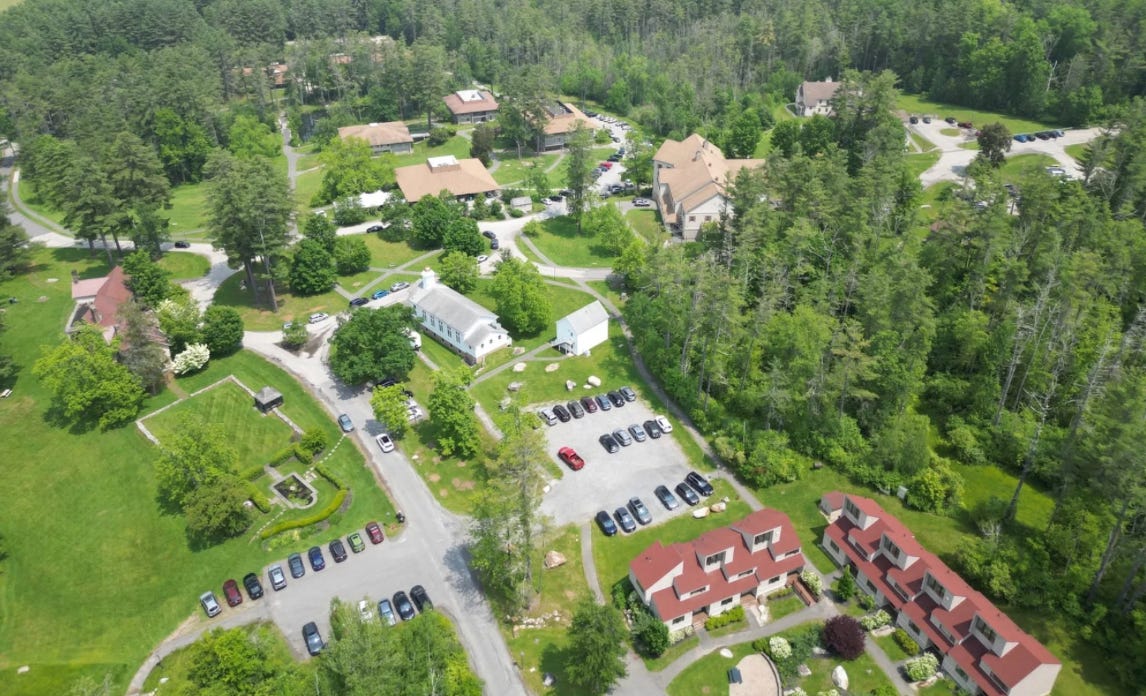
Step two toward new revenue generation was taken at the June 1st meeting of the Finance Committee and Select Board, where a discussion about Simon’s Rock’s mostly abandoned 271-acre property resulted in an adjusted assessment, to just under $36,000,000, as well as the college’s first tax bill.
While Bard College has paid their first and second tax bills totaling $263,469, it’s none too happy about it. Their CFO Tuan Toay was quoted in August calling the assessment a “rash decision” that “has us rethinking continuing to operate the public parts of the property.”
William Doherty, Clerk of the Appellate Tax Board, confirmed that Bard College filed a formal appeal petition with the ATB on September 28th. As of November 17 no motions have yet been filed or hearings scheduled in their case, but according to Schilling, Bard has told the town to be in touch with their attorney regarding inspections. The town, for its part, is apparently representing itself in the dispute.
Now, as it had threatened to do, Bard College has decided to shut down the Kilpatrick Athletic Center on December 31. The center costs about $25,000 per month to operate, on top of member dues.
Under and Overassessment
The unhappiness over tax assessments will extend much farther than one property owner if the town — and other South Berkshire towns — get around to updating assessments on the private properties on their rolls, especially those of high-value homes.
This is because under current assessments the higher the home value the more likely it is to be unfairly assessed in the homeowner’s favor.
In fact Berkshire County, according to a 2024 study conducted by the University of Chicago Center for Municipal Finance and covering the years from 2015-2024, has the most regressive property assessments of all the 14 counties in the state, and therefore the widest “unfairness gap” between the assessment of poor and rich homes.

Across their 2024 sample of 775 arms-length sales (meaning open market sales and not transfers between family members) in Berkshire County, the most expensive homes sold were assessed at 73.6% of their sale price, while the least expensive homes were assessed at 107% of their sale price.
Why is that?
In a resort market like ours, ordinary homes — those which sell for between, say, $300,000 and $700,000 — sell often enough that assessors can value them accurately based on available sales data. High-end properties, however, change hands far less frequently, which means there are too few comparable sales to assess them accurately according to the rules.
As top-end prices locally have raced upward in recent years, assessments have fallen far behind in that range, and so the most expensive homes end up taxed at a number below, sometimes well below, what a buyer would actually pay.
If Berkshire County is the most unfairly assessed county in the state, there’s further evidence that Stockbridge, West Stockbridge and Great Barrington are among the most unfairly assessed towns.
The Chicago study determined that Berkshire Hills Regional School District showed the widest gap of the intra-county school districts examined. The cheapest homes in those three towns were effectively taxed at more than double the rate of their most expensive homes.
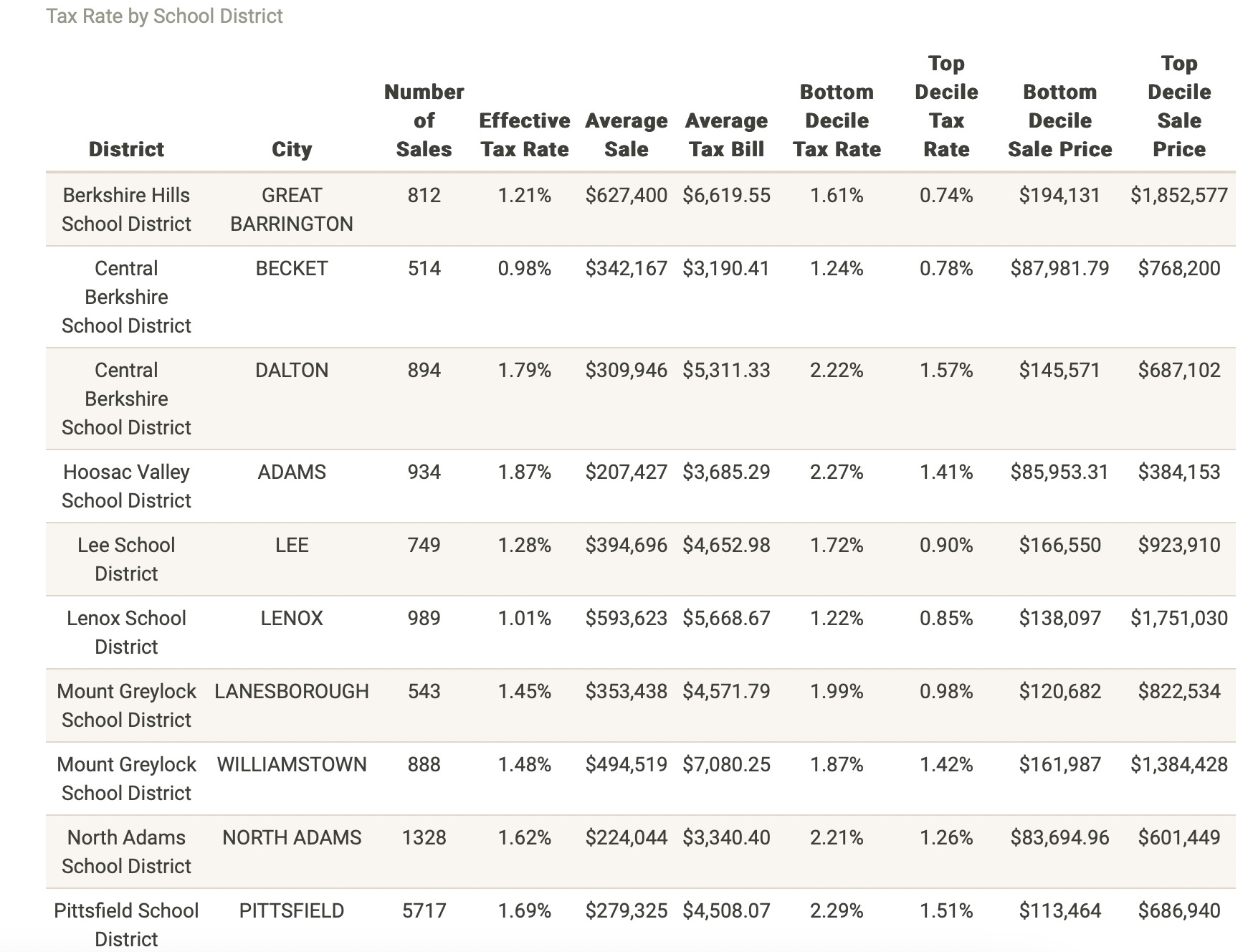
The relevant numbers to compare in the chart above are
BHRSD’s Bottom Decile Tax Rate: 1.61%
and
BHRSD’s Top Decile Tax Rate: .74%
The homes on the lowest value end of the spectrum are taxed at an effective tax rate more than twice that of the highest value homes. In a fairer system the two figures would be the same and share a rate of, say, 1.21% or so.
To put a dollar figure on what that means for taxpayers:
The owner of a top-decile home selling at $1,852,577 paid about $13,709 in taxes at 0.74%.
With a 1.21% tax rate they would have paid $22,416 — roughly $8,700 more.
The owner of a bottom-decile home selling at $194,131 paid about $3,126 at 1.61%.
At 1.21% they would have paid $2,349, or about $800 less.
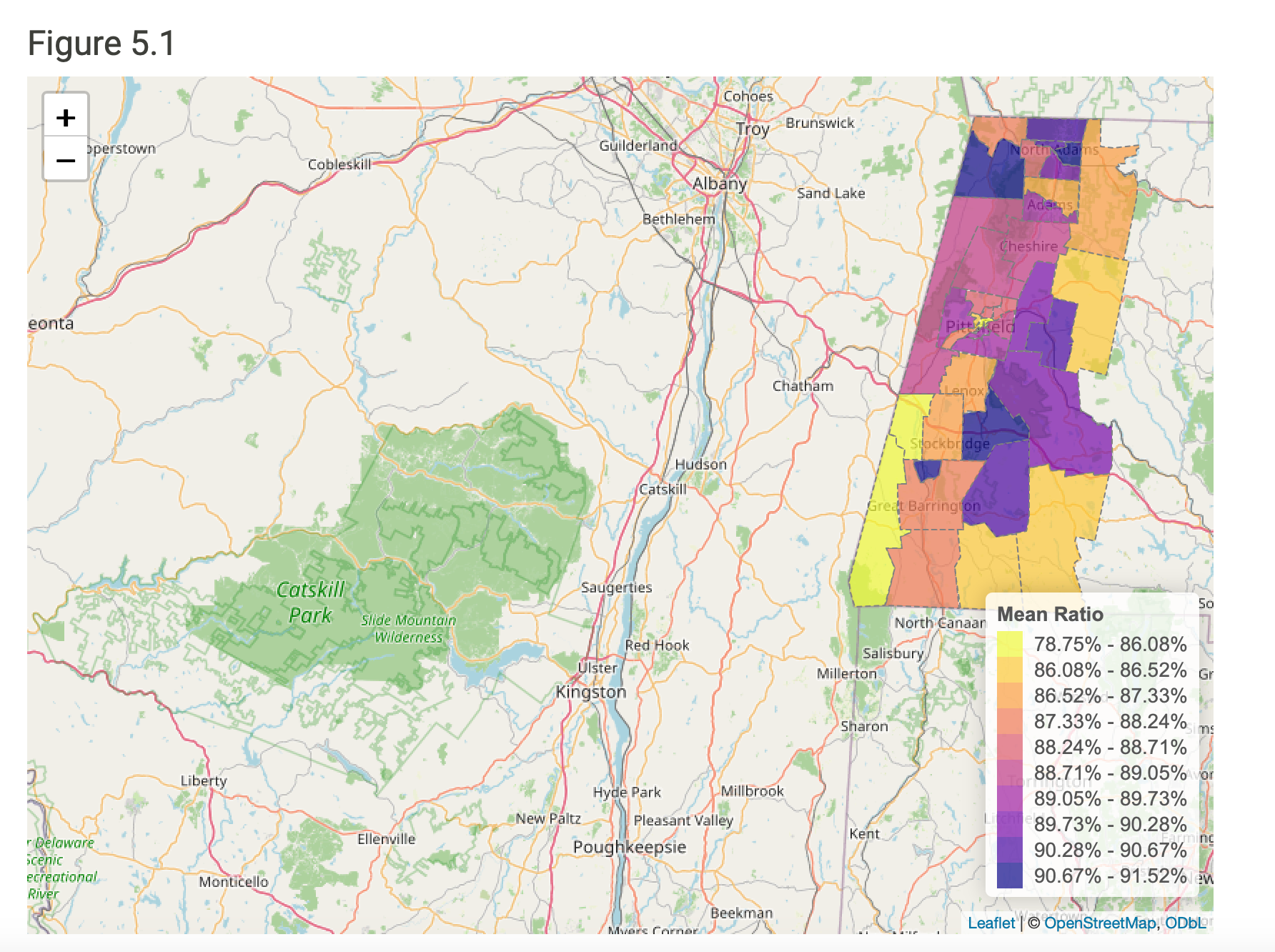
Assessments in Great Barrington, Sheffield, Stockbridge, Lenox, New Marlborough, Sandisfield and especially West Stockbridge, Egremont, Alford and Mount Washington, are behind neighbors like Lee, Tyringham, Monterey and Pittsfield in keeping in line with market values. (See graphic from the study below.)
How the Assessment System Works
Our homes are meant to be assessed at their “full and fair value.”
Full and fair value, according to the legal framework for assessments as laid out in Massachusetts General Laws Chapter 59, refers to the amount a homeowner could expect to get for their house in the real estate market at that moment in time. A house should therefore be assessed for $500,000 if the house would sell for $500,000. Assessors uses a Computer Assisted Mass Appraisal (CAMA) system to make these evaluations. Where would an assessor go for data to plug into CAMA? They’d look at the style of house, its square footage, how many bathrooms and bedrooms it has. They’d note if improvements had been made, or damage done, to the property since the last assessment. They would consider its location.
But most importantly they would rely on sales data.
The median sale price for a home in Great Barrington rose from $262,000 in 2015 to $305,650 in 2019, then to $524,700 in 2024, and to over $700,000 as of October 2026. The number is likely to continue to climb as the construction and sale of ever-higher-end homes persist. But assessors need a data-rich source of comparable properties, and at that end of the market properties have not sold in high enough numbers to meaningfully move the needle on bringing assessments up and increasing Great Barrington’s tax base.
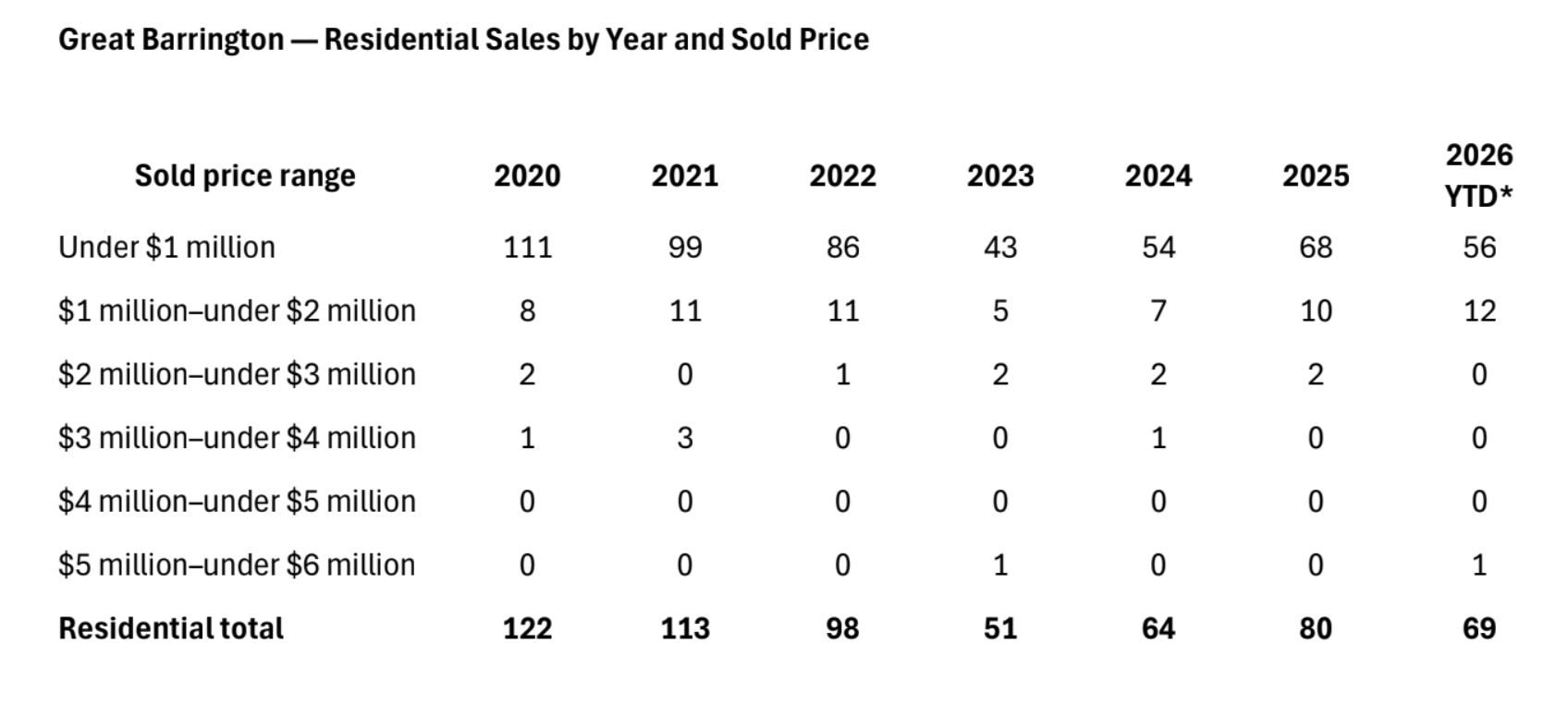
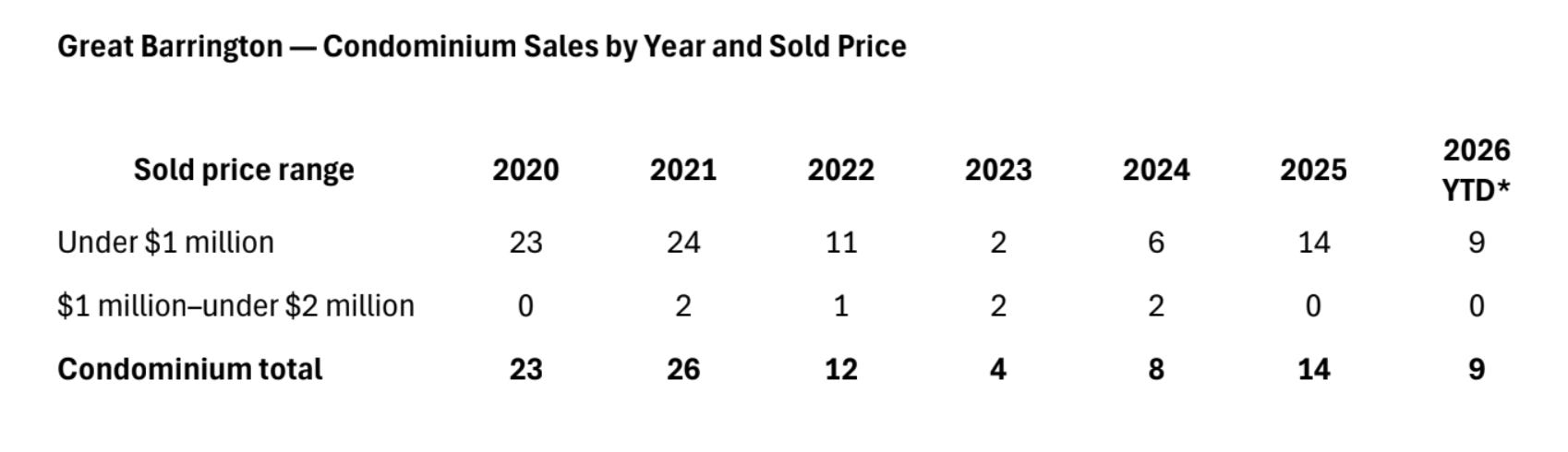
The numbers under the years in the sales chart below provided by Berkshire County Realtors Association indicate houses sold in that category in Great Barrington. Most homes sell for under $1,000,000 and in the $300-$700,000 range they turn over with reasonable frequency. Above $1 million, however, sales thin out, and get very sparse above a sales price of $2 million. There were three sales over $2 million in 2023 and 2024, two in 2025, and one so far in 2026.
More Assessment Challenges
Great Barrington’s assessor Emily Schilling, who came to town from the Pittsfield Assessor’s office in July 2025, said that she’s always been told that it takes a minimum of three comparable sales as a baseline expectation to make a fair assessment. “Outlier” properties, such as the 13,000 square foot estate at 250 Long Pond Road, the one house in town that sold for more than $5 million this year after 15 years on and off the market, are supposed to be put into their own “neighborhoods” for assessment purposes. (In the end 250 Long Pond sold for just under $6 million and was assessed for over $6 million, so it worked against the trend toward the higher the value the more likely to be assessed lower.)
But Great Barrington does not have the staff, software sophistication or real estate stock to maintain separate neighborhood models for outlier properties. A designation based here on just one or two sales means it would be mostly dependent on one assessor’s judgment call and would likely not pass the state standard for comps. That makes the assessment vulnerable to an abatement demand by the homeowner, who might reasonably ask, “How do you know my house would sell for $6 million? Where’s your evidence?” The assessor, in that scenario, would have to err on the conservative side, and conservative on a $5 or $10 million home means a much bigger dollar gap than conservative on a $500,000 home. That gap, on a single high-end property, can run to seven figures in uncaptured valuation.
In coming years, as higher end homes sell in greater numbers, that broader foundation of sales data will presumably enable Schilling’s office to more confidently peg higher-end assessments to demonstrated market values.
(According to state rules, properties are supposed to be re-evaluated every five years, and the assessor is supposed to personally assess each one every ten years.)
Among other tools to use in that work going forward, Schilling says she would like to use construction cost per square foot more in her assessments, saying, “That’s something I think that needs to be looked at here more in depth.” She’s been trying to get on top of things, but she’s one person, with one assistant, working with a lot of deferred assessment maintenance.
As she presented on June 1, just getting Simon’s Rock’s 17-parcel property in order would be a bear to assess.
How much time and software alignment and market data revising would it take to ensure all of the town’s properties reflect current real estate realities? Given the present fiscal realities and staffing and software constraints it would likely take many years. In the meantime the town will collect what it needs to collect, and assessment shortfalls at the top end will be made up for elsewhere.
In a future analysis for paid subscribers, The Village Green will look further into what the sales data say about how the assessment system is changing.
Great job cracking into this problem.
I would also be very interested to know how much money, if any, Bard has paid the town in payments in lieu of taxes (PILOT) over the years. I’m sure the town can provide that data easily.
Great reporting. Thanks.