

For a comprehensive explainer on the 2027 Massachusetts ballot questions, see the Tufts Center for State Policy Analysis.
Paid subcribers will receive the Village Green’s editorial stances on the 9 questions prior to November 3.
Claude AI assisted in the following analyses.
*
QUESTION 7: WHETHER OR NOT TO OVERRIDE LOCAL ZONING RULES IN ORDER TO CREATE MORE HOUSING
Question 7 is known informally as the “starter home” initiative, because it is aimed at meeting the need for more affordable housing in the state.
It would prevent cities and towns from requiring more than 5,000 square feet of lot area and 50 feet of frontage to build a single-family home on lots served by public water and sewer, while maintaining local control for height, setbacks, open space, parking and short-term rentals.
This question came about through an initiative petition filed in August 2025 and led by Andrew Mikula, senior housing fellow at the Pioneer Institute, with support from pro-housing groups including Abundant Housing Massachusetts.
The Secretary of State’s voter guide lists Wesley Lima of Legalize Starter Homes as the leading proponent of Question 7.
The opposition to Question 7 is led by the Massachusetts Municipal Association, whose argument centers around the loss of local control. Approval would mean overriding the planning of all 351 cities and towns in the Commonwealth, regardless of infrastructure, water and sewer capacity or neighborhood character.
The following are summaries of the mixed impacts of Question 7 on residential zoning in Great Barrington, West Stockbridge and Stockbridge.
NOTE: R1, et cetera, refer to each town’s residential zones. Keep in mind, again, that only lots which access town water and sewer apply to Question 7’s rules.
GREAT BARRINGTON
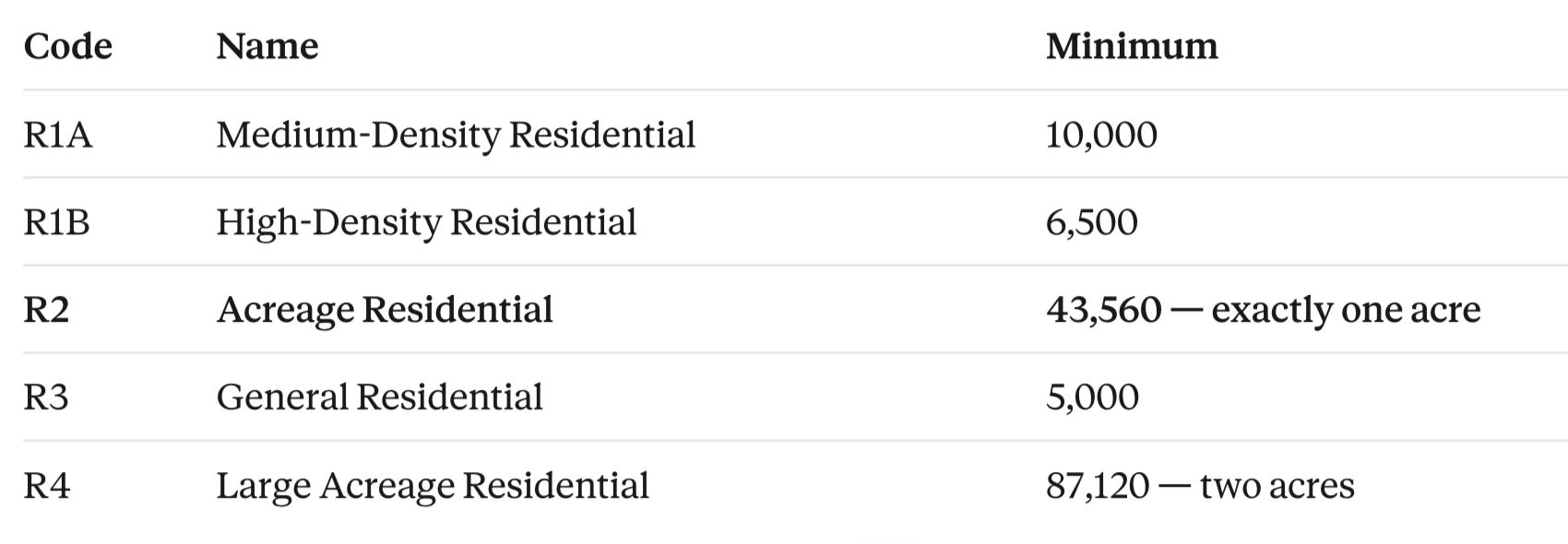
Question 7 would override Great Barrington’s minimum lot sizes in three residential districts on parcels with both town water and sewer, and in two of those three the town’s side-yard setbacks, which the measure leaves untouched, would still leave almost nothing to build on.
WEST STOCKBRIDGE
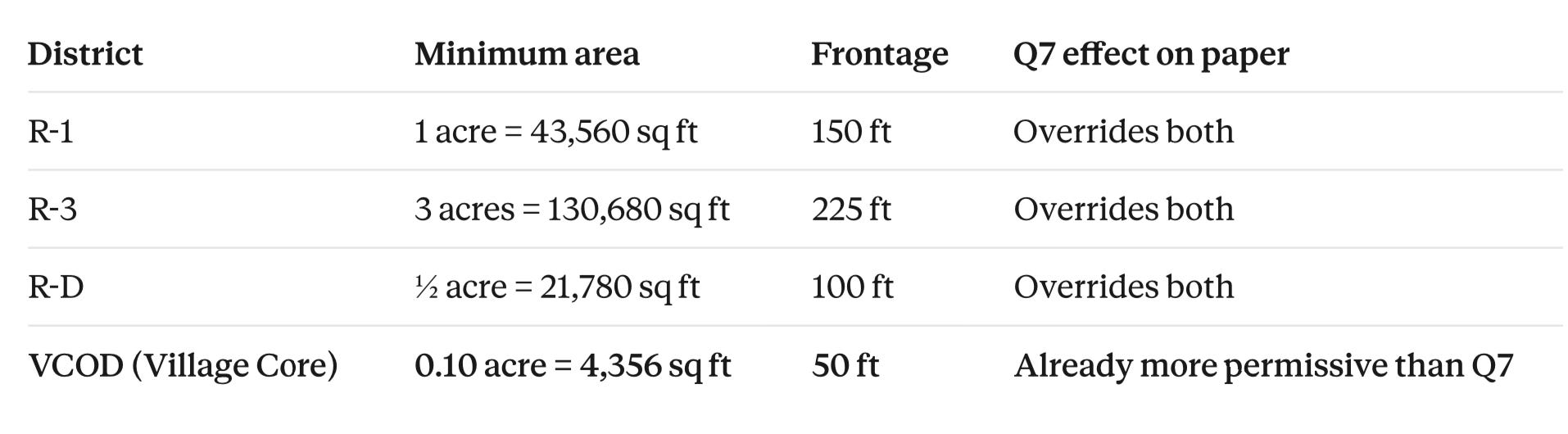
Question 7 would override West Stockbridge’s lot minimums in R-1, R-3 and R-D — but the town’s Village Core district already allows lots of 4,356 square feet. In R-1 and R-3, 25-foot side yards on a 50-foot lot leave nothing to build on.
STOCKBRIDGE
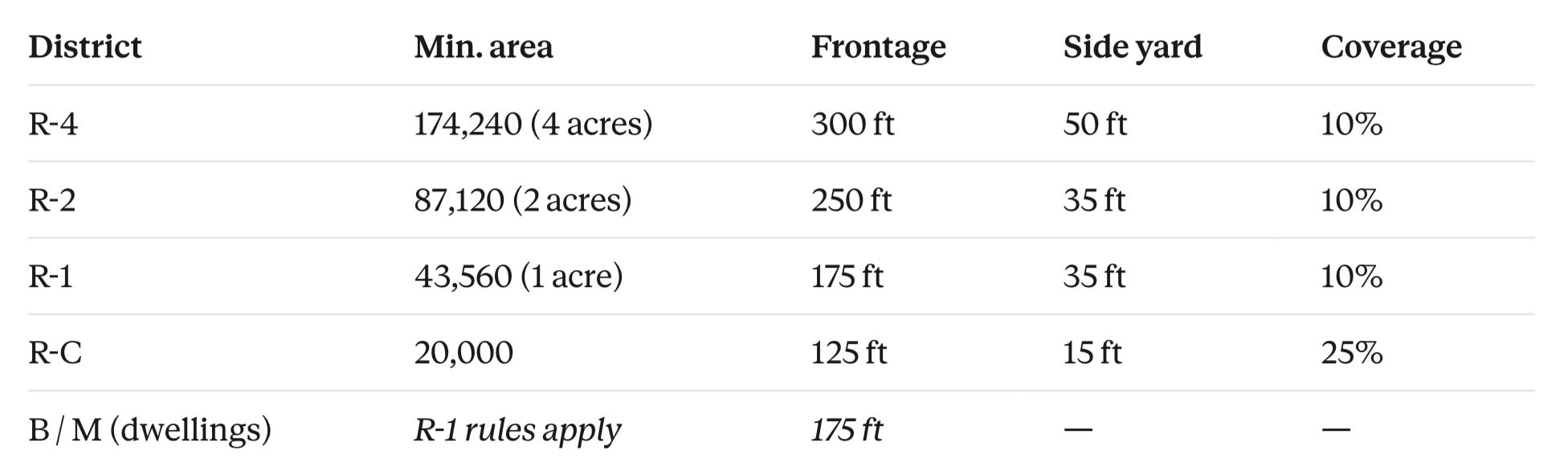
Question 7 would override Stockbridge’s minimum lot size in every residential district, and in R-4 by a factor of 35. But Stockbridge’s side-yard setbacks of 35 to 50 feet would leave a 50-foot-wide lot with no buildable width at all. Only in R-C, the smallest district, could a house actually fit.
The Center for State Policy Analysis had this to say about the modest impact of Question 7:
It would:
“Generate roughly 750 new homes per year. That is our central estimate, but the analysis involves a lot of uncertainty, and our modeling suggests a plausible range from 350 to 1,200 per year.
New construction at this scale would have a real but modest impact on overall production, increasing single-family home building by roughly 15 percent and overall housing development by roughly 5 percent.
Cities and towns would lose some real authority over roughly 850,000 parcels whose construction rules would now be governed by Question 7.”
High density suburbs, not rural regions like ours, would see the greatest change to their existing zoning laws.
QUESTION 8: REPEAL OR NOT TO REPEAL THE RECREATIONAL CANNABIS LAW
In terms of money and attention paid, Question 8 far surpasses any of the other ballot measures voters will be considering on November 3rd.
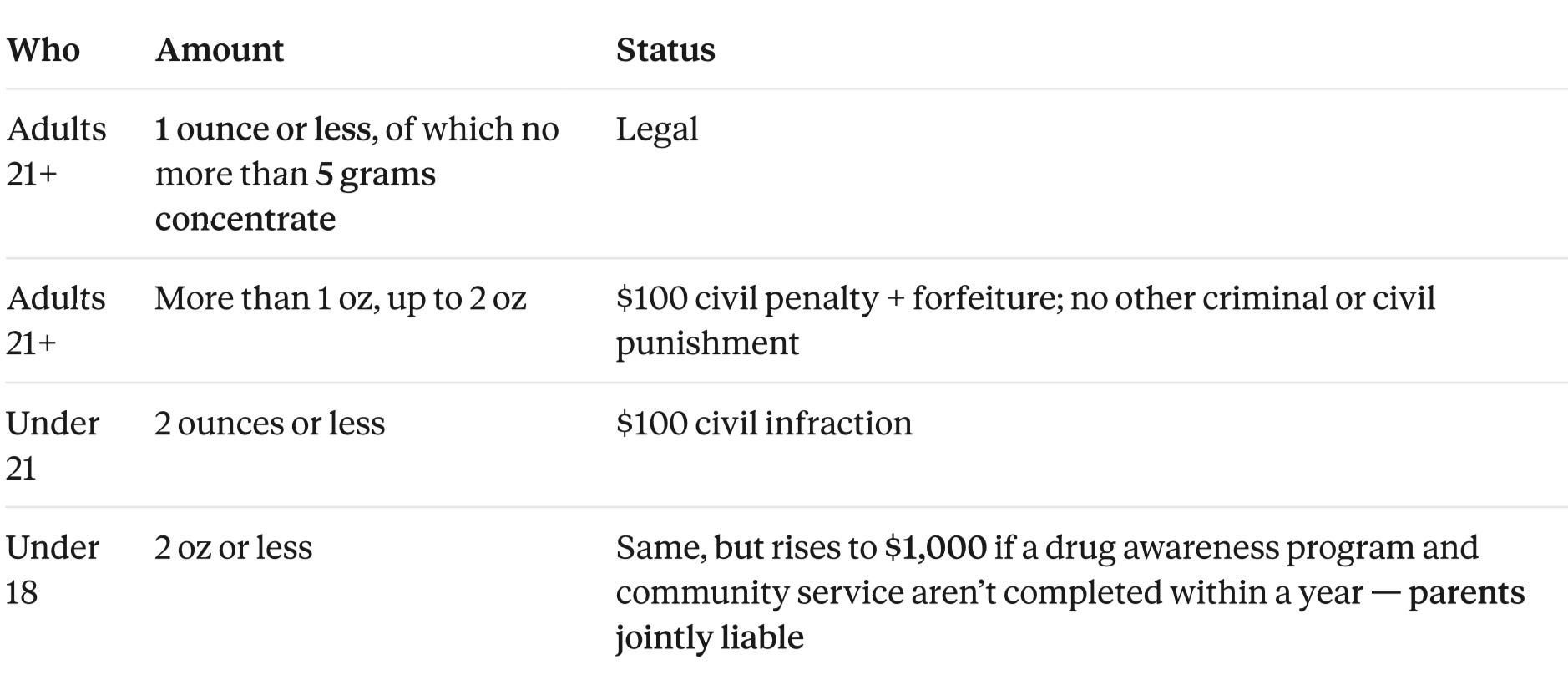
Question 8 would reverse — as of January 1, 2028 - the vote of Massachusetts in 2016 to legalize recreational marijuana. A YES vote would not recriminalize the drug, but would dismantle the cannabis industry across the state and compel recreational dispensaries — including the five in Great Barrington — to shift to a medical marijuana license in order to stay in business.
As for changes to possession rules for individuals under Question 8, they would be as follows:
Question 8 was brought to Massachusetts voters by a Virginia-based group called Smart Approaches to Marijuana, and was supported in-state by the Coalition for a Healthy Massachusetts, whose petition got 78,301 signatures, including 1,148 in Berkshire County.
The Center for State Policy Analysis’ findings on Question 8 are:
“Marijuana use can have real, sometimes irreversible harms—especially for young people. Serious risks like addiction and psychosis are increasingly well-established by research.
Eliminating recreational sales would likely reduce overall marijuana use. But it would also increase black market activity—and the policing necessary to curb it.
While Question 8 explicitly allows for medical marijuana, the state currently lacks a robust system for licensing and overseeing that industry.”
The YES campaign has raised more money total, but spending on the YES and NO sides has been fairly even, at least in 2026.
Note that of the roughly $3.5 million raised to repeal legalization, $3.48 million came from SAM Action, while Massachusetts residents contributed a total of $1,625.

Tax revenue from cannabis businesses has been the most oft-cited benefit of maintaining the industry and oppositing Question 8.
For context, here, from the Department of Revenue, are the cannabis tax revenue numbers for Great Barrington from the opening of Theory Wellness to the present day, with five open dispensaries.
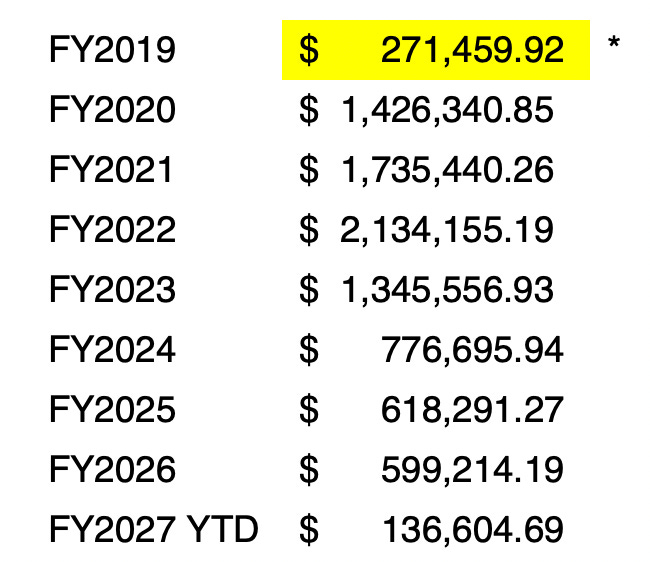
The high point was 2022, and 2026 that number has been reduced by about two-thirds, to just under $600,000.
The NO on 8 side has been winning at the South Berkshire County lawn and billboard signage game. In fact, the YES side seems to have defaulted. If anyone has seen a public YES on 8 sign please send in a photo to info@villagegreennews.com.
NOTE:
Paid subscribers will receive our unorthodox take on Question 8 — that it’s asking the wrong question - after the election.
Become a paid subscriber today to ensure you get that piece in your inbox, and gain access to all future analyses, opinion and investigations.
*
QUESTION 9: REPEAL OR NOT TO REPEAL THE 2024 GUN CONTROL LAW
Question 9 asks voters to do the opposite of what the other measures seek to do.
A YES vote keeps the 2024 law.
A NO vote repeals it.
It’s called a veto referendum.
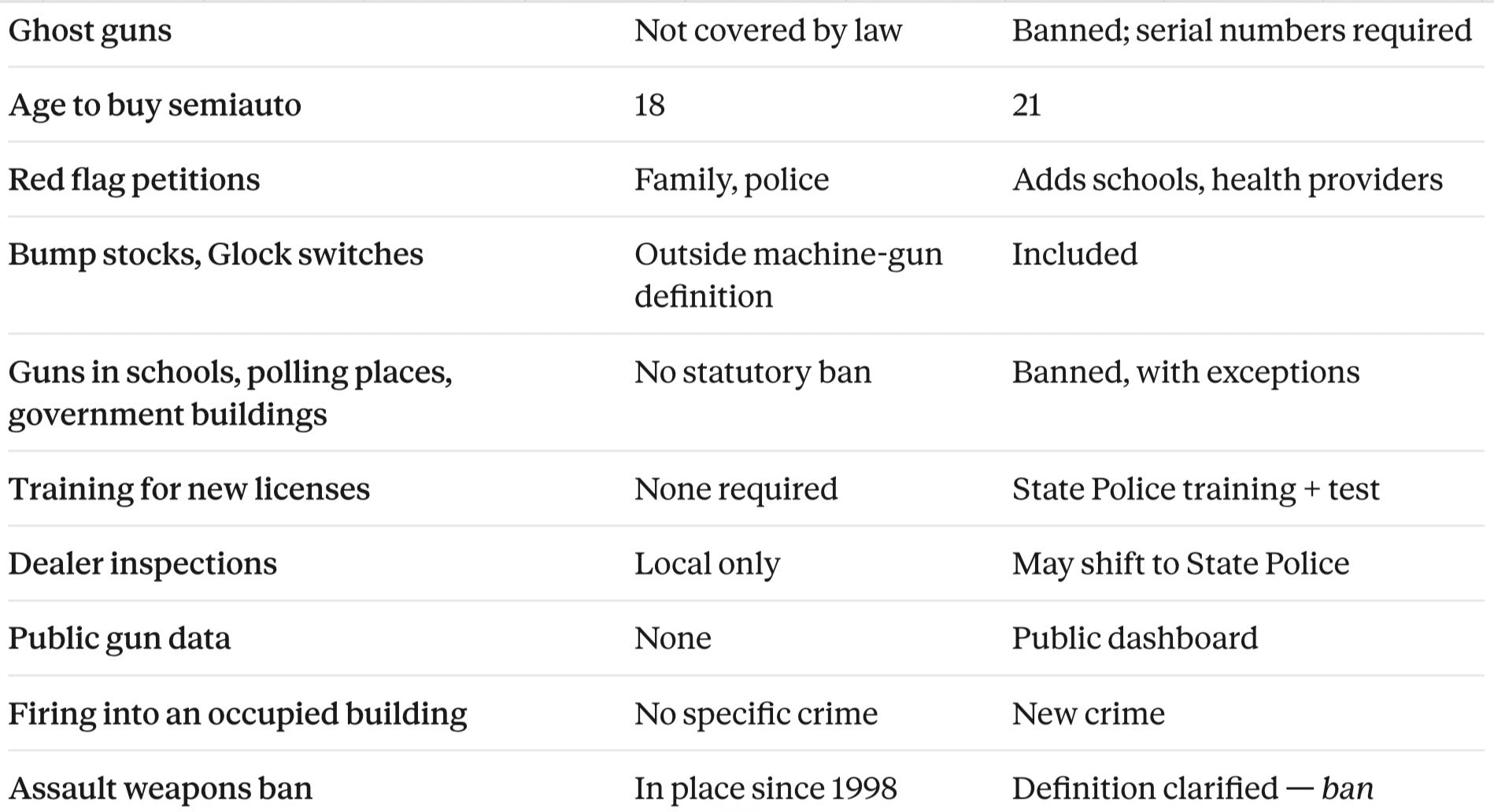
In 2024 the state enacted a series of gun control rules as part of a comprehensive law. Question 9 would repeal that law and revert the state to the prior set of restrictions.
RULE PRIOR to 2024 UNDER THE 2024 LAW
The veto push was brought by The Civil Rights Coalition, led by Toby Leary of Cape Gun Works in Hyannis. Among its financial backers is Smith and Wesson of Springfield.
The pro and con sides on Question 9 are fairly evenly-matched in campaign spending. Yes for a Safe Massachusetts has spent $653,000 through October 20, and the Civil Rights Coalition $457,544.
The Center for State Policy Analysis found on Question 9 that:
“The 2024 law closed some genuine gaps in prior state rules, allowing Massachusetts to track home-assembled and other so-called “ghost guns” and adding school administrators, healthcare providers, and police officers to the list of people who can seek “red flag” orders removing guns from people who pose a risk.
Lawful gun owners face some new obligations under the law, including registering all firearms with the state.
If the 2024 law is repealed, Massachusetts would still have its former rules—already considered among the strictest in the country. The state would still require gun licenses and safety training, track firearm sales, and allow family-initiated red flag petitions, among other protections.”
Both YES and NO on 9 signs can be found sprinkled around South Berkshire County, though some of the NO signs have been repurposed by the NO on 8 folks.