

I meant to write a neutral, even-keeled news update, a follow-up to the neutral, even-keeled news story I put out Thursday about the Code Red Alert from the Housatonic Water Works Company, starting with this disclosure: The writer is a West Stockbridge HWW ratepayer and did not receive a notification about the need to conserve water.
Typing that sentence, though, I realized I was too angry to write a news story. So here’s a request on behalf of myself and HWW’s roughly 850 other customers of the people in Boston with the power to act.
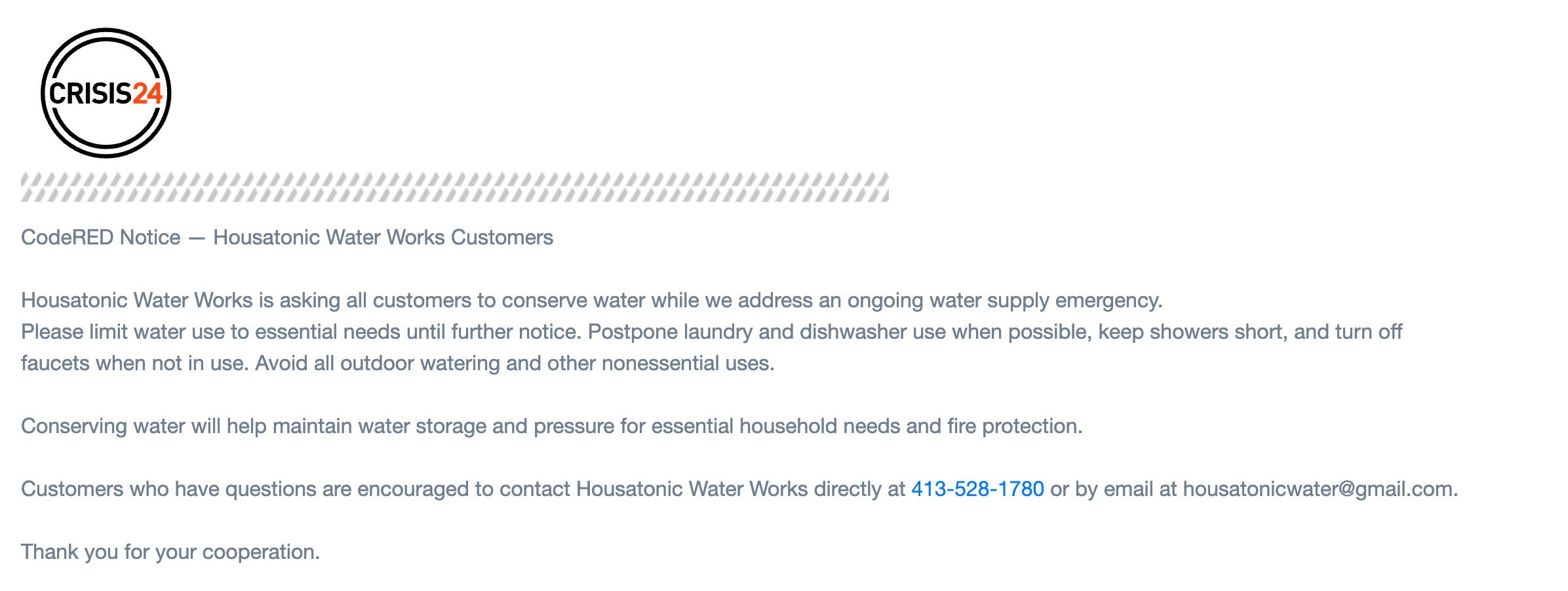
A little before noon on Thursday, November 5, HWW customers who’d signed up for CodeRED alerts received a request to cut their water use. The 94-word alert suggested we “keep showers short” and “postpone laundry and dishwasher use.”
It closed with “Thank you for your cooperation,” like it was written by Smokey the Bear, urging us to help prevent forest fires.
But we the ratepayer cannot help prevent the water from leaking, and it is a leak causing the problems, which the alert did not mention.
Customers learned about the leak from Rep. Leigh Davis, who heard about it from MassDEP and told us Wilkinson Excavating would get to it as soon as possible on Thursday.
[On that note, here is a late-breaking update from Rep. Leigh Davis: (Nov 6, 2:25pm)
Lenox Construction is scheduled to begin repair work near Van Deusenville Road and Oak Street on Monday. The leak is estimated at approximately 20 gallons per minute. Conservation efforts have helped stabilize water levels in the storage tanks, so please continue to conserve water.
MassDEP continues to monitor water quality and tank levels and is holding daily meetings with Mercer. I’ve also asked Jim to communicate directly with his customers rather than relying on others, including me, to provide updates. He said he would.]
It’s not clear how Jim Mercer will accomplish those updates, unless he’s just hired a dozen employees to manage a phone bank in his office, which would be the only way to render operable the phone number at the bottom of the alert.
As it is, my calls went straight to voicemail at noon, 1 p.m. and 2 p.m. Thursday, and again at 10:30 am and 3 pm Friday.
Facebook was, per usual, a far better source of information and solidarity than the company. Here is a sampling of what HWW customers asked on the Great Barrington and Housatonic forums Thursday and Friday:
How can we receive a code red message like this with zero context or explanation?
Did something new change or break? Is someone working on something that means this will eventually be resolved? Are we in fact about to loose [sic] running water in our homes?
Are we all supposed to contact HWW individually to ask the basic obvious questions about what happened and how long this will go on?
Is HWW asking us, its long-suffering rate payers, to do THEM a favor? Or is the water supply actually in danger?
WTF is going on?
None of this was inevitable.
For decades, the Great Barrington Fire District has replaced their old pipes as they aged. Had HWW followed that example, a dry tap in Housatonic would now be unthinkable.
In his open letter to Governor Healey, Selectboard Vice Chair Eric Gabriel asked why the Mercers have kept paying themselves six-figure salaries, with annual raises, while their company slid toward bankruptcy.
The company may be going broke, but its owners are not.
HWW treasurer James Mercer owns homes, units and parcels in Great Barrington assessed, conservatively, at well over $6 million. He could sell a couple, pay the company’s bills, and still hold millions of dollars in real estate.
But no one can make him. Under Massachusetts law, a company’s debts belong to the company, not to its owners. No state regulator can order HWW’s shareholders to put in their own money. And the state’s receivership law, which lets a court put new management in charge of a failing utility, covers only small electric and gas companies, not water companies.
Connecticut’s water receivership law lets the state, towns and customer groups ask a court to place a mismanaged water company under a receiver. It also lets the court hold directors and officers personally liable when they have diverted the company’s money or engaged in willful misconduct.
Limited liability is how most businesses work, and for most businesses it should be. But HWW doesn’t sell purses, soda, shotguns, nail polish, weed, wine or bread. It sells water, which no person or animal can go without. A company that holds the only tap in town should not be able to collapse while its owners walk away untouched.
And the state already knows what to do!
In September 2025, the private Andrews Farm Water Company left about 53 homes in Boxford, Mass without water and stopped answering the town’s calls. Governor Healey declared a water emergency, and the Department of Public Utilities put Aquarion Water Company in charge of the system. Within days, water was flowing again.
Bruce Tarr, the State Senate minority leader said of that case: “This company has a moral obligation and a legal obligation to fulfill the commitment that it has to these residents….No one should have to come home and wonder if they are going to be able to turn on the tap and get safe water to drink and to cook with.”
Governor Healey, for her part, said the company “has failed” in its responsibility to provide safe, clean water.
Housatonic Water Works has about 850 customers, or 16 times as many as the Andrews Farm Water Company in Boxford.
It’s fallen more than $116,000 behind on its bills to the Fire District for an emergency water connection and the Fire District is running out of patience.
It has a leak, or multiple leaks, which have caused steep reductions in water levels that threaten our water supply and which won’t be addressed until Monday.
It doesn’t answer its phone.
If Andrews Farm met the bar for state action, so does HWW.
Here’s what I am asking for.
Governor Healey: declare a utility emergency for Housatonic Water Works customers now, as you did for Boxford, so the DPU can put a qualified operator in charge of the system. The governor and legislature should help cover those costs so Housatonic ratepayers aren’t billed again for the owners’ failures.
Rep. Leigh Davis and Sen. Paul Mark: when the new legislative session opens in January, file a bill giving Massachusetts a water-company receivership law. Model it on Connecticut’s. Let towns, customers and the attorney general ask a court to replace failing management.
We tend to associate a lack of clean water with the developing world. I’ve lived in the developing world. In 1998 I lived through a months-long drought in the highlands of Papua New Guinea, where the average resident gets by on about a dollar a day.
Not once was I in danger of a dry tap.
Sit with that for a minute. The last time this Housatonic Water Works ratepayer had reason to worry about running water was in Papua New Guinea.
I’ll give the last word to my friend Theresa Tatro of Oak Street, who joins me for trivia at the Common Pub but not for watching town meetings on YouTube. On Thursday, for the first time, she called Governor Healey’s office. She left a message that went something like this:
Hi. I’m just little Theresa Tatro, Oak Street, Housatonic. I don’t know if you guys have eyes on this water situation or if there’s something being done, but I’m just trying to understand this. I don’t want to be a complainer. I’m just throwing a hail mary here.
Governor, please catch it.
Here here! And well said. Thank you Sheela for being a voice for all of us in this sad hamlet whose woes are consistently kicked down the road by the state. We are all fed up.
I have a request. I would like to understand the legal repercussions if ratepayers opt to not pay our water bills. Could you write a piece on that? Or would you be declared an insurrectionist organizer? I would not want that for you, of course, but I really would love some reliable information on what leverage we ratepayers have, other than continuously pestering our reps and the DPU to no avail. I've heard talk of putting our rate checks into escrow. Would this serve our goals?