

Note 1: Claude AI parsed 87 years and more than 4,500 pages of Housatonic Water Works Company annual returns to the Department of Public Utilities.
Note 2: HWW Treasurer James Mercer was given the chance to answer a series of detailed questions based on this analysis by email on Tuesday, Nov 10 and did not respond in time for publication.
Note 3: I have been a HWW customer in West Stockbridge since 2003.
Introduction
The Town of Great Barrington is in active deliberations with Housatonic Water Works to acquire the private utiltity from Fred and James Mercer.
In addition to a presumably seven-figure sale price and $30+ million in necessary infrastructure upgrades that would fall to whoever does take it over, there could be another big liability on the books.
$2,596,384 is listed under Account 315 on HWW’s filings to the Department of Public Utilities as “unpaid compensation” due to company officers, and no one has yet explained if this IOU would be paid out or nullified in a deal. When asked about it Town Counsel referred me to a press release that didn’t reference account 315 and neither the Company nor DPU responded to requests for clarification. An explanation of account 315 is below in part 5 of this analysis, below.
HWW has acknowledged that it's in a fiscal crisis.
It’s currently using an emergency hook-up to Great Barrington Fire District’s water supply to serve all of its 850-odd customers but insists it cannot afford to pay those water bills, and in just the past three weeks it’s shut off water twice in Housatonic to fix major leaks.
In their disclosures to DPU during the rate increase request process in 2023, HWW treasurer James Mercer and counsel shared annual company returns starting in 1938, and the following analysis is based on those returns.
Earlier returns dating back to 1889, the first year of the company’s operations, were apparently not to be found.
The Mercers took over ownership of HWW in 1984 from Barbara Pearson, the widow of the grandson of the original owner, Fred Pearson.
1) What HWW has spent on maintenance
Under Pearson’s management HWW spent, on average, 9.2% of annual revenue on system maintenance.
On the left side of the chart below maintenance spending spiked in 1976 with nearly 30% of company revenue spent.
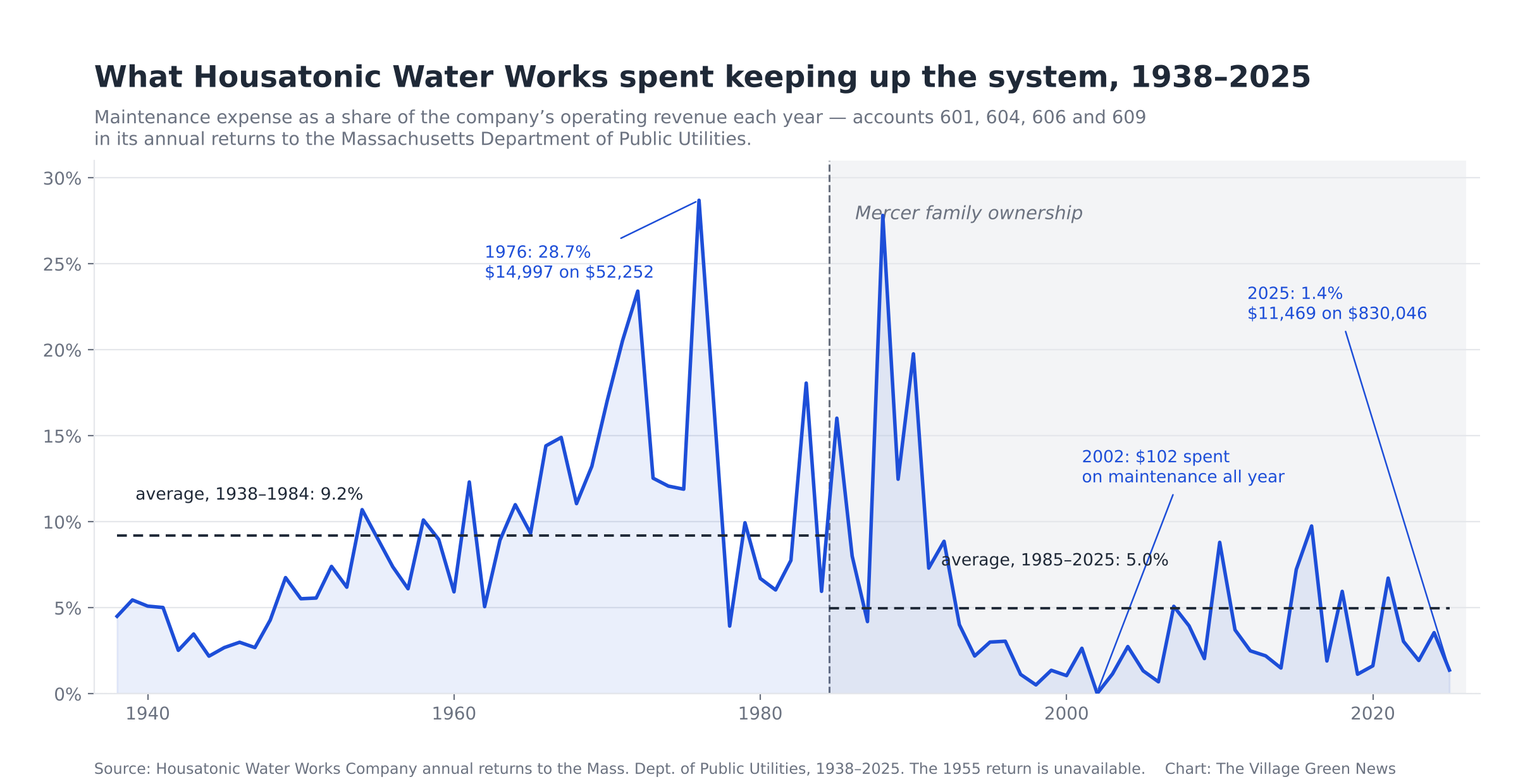
On the right side of the chart, apart from their first couple of years of ownership, during which maintenance spending matched that of the prior owners, the Mercers have spent less.
Between 1985 and 2025 HWW spent an average of 5% of annual revenue on maintenance.
How much should they have spent?
While utility companies are expected to spend every year on maintenance, there’s no universal expectation of how much because every water system is different. A clean, deep well needs very little maintenance, but a surface water filtration system delivered through pipes laid at the turn of the 20th century needs a lot of maintenance.
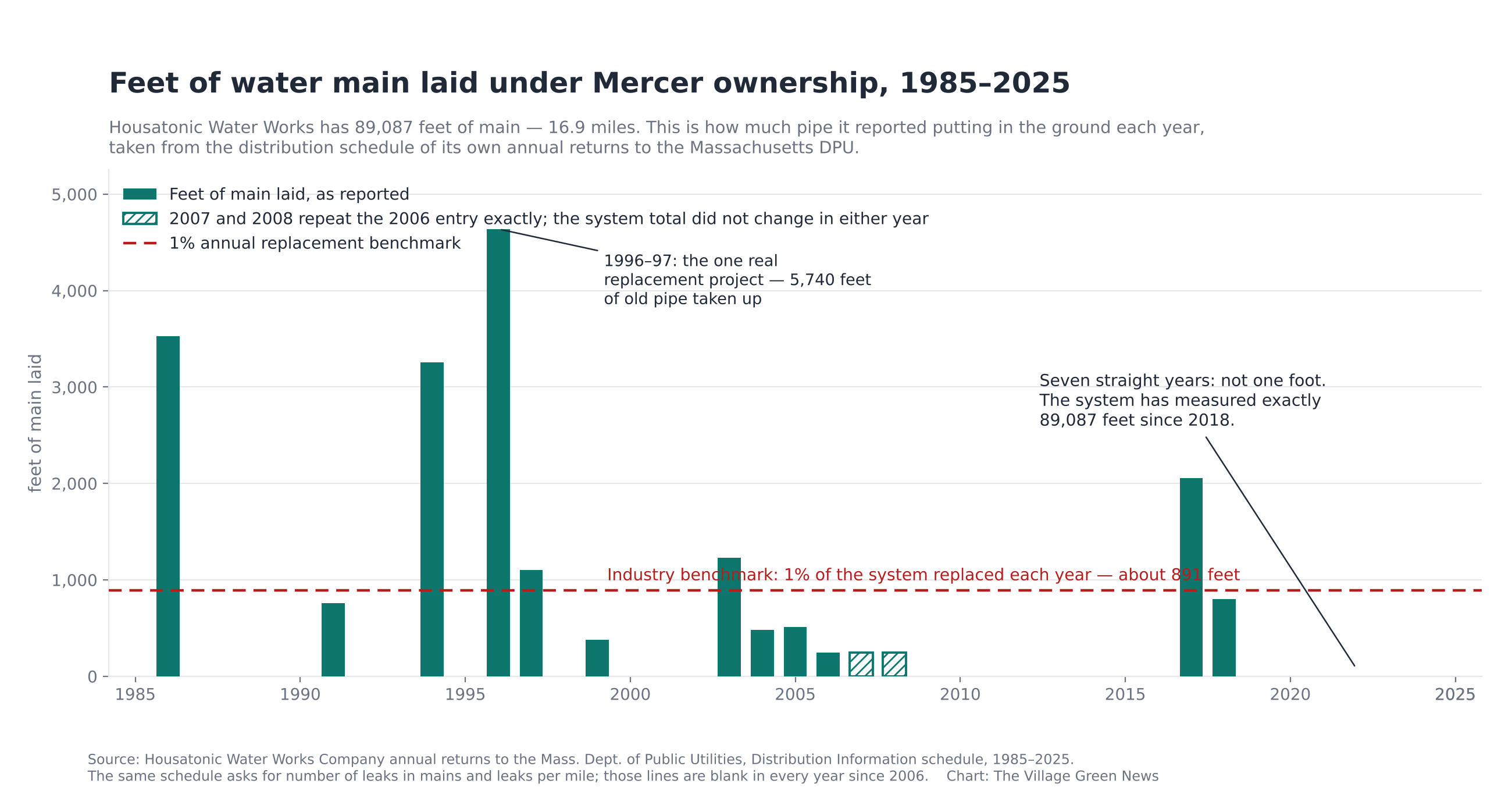
HWW filters its water out of Long Pond and delivers it to customers through 16.87 miles of such pipe. In terms of replacements, the industry expectation is that pipe lasts 100 years so you should replace about 1% of the system annually.
16.87 miles equals 89,087 feet, and 1% of that distance is 891 feet, so HWW should have been replacing 891 feet of pipe a year. HWW has replaced 14% of the old pipe since 1984, so 86% of what the Mercers inherited is still in the ground.
At 1% a year, 41 years would have updated about 41% of the system.
Between 1985–2005: 15,878 feet of water main were laid, or about 756 feet a year.
That’s 0.85% annually, not far off the industry benchmark.
Between 2006–2025: 3,597 feet of water main were laid, or about 180 feet a year.
That’s 0.20% annually, or 1/5th the industry benchmark.
Not all of that footage was replacement. The system grew from 80,949 feet in 1984 to 89,087 today, so roughly 8,138 feet went to connecting new customers rather than renewing old pipe.
They’ve not laid any water main pipes since 2018.
[It should be noted that American water companies in general are behind on maintenance.]
2) What HWW has spent on legal fees
Over 41 years of Mercer ownership HWW has spent almost exactly as much on lawyers as it has on maintaining the water system.
Legal fees: $644,158
Maintenance of water system: $687,792
Prior to 2021 that line item was minimal, just 1 to 2% of revenue, though there were two early spikes: $33,353 in 1991 and $42,669 in 1995.
As of 2021 the number really explodes.
In the past five years the company spent $339,549 on attorneys, or more than half of the 41-year total. For reference, over the same five years they spent $122,267 on maintenance.
HWW’s legal bill for the year 2024 totaled $165,107.
Presumably most if not all of that money went for services rendered to push through the rate increase, which was a 14-month process.
Housatonic Water Works taxpayers are also paying, of course, for the legal costs associated with the town’s years-long battle with the company.
[Another line item is worth noting. Account 610-11, “Miscellaneous General Expenses,” has grown from $15,005 in 2014 to $193,744 in 2025. It’s now nearly a quarter of everything the company collects. The annual return carries no schedule explaining what is in it.]
3) What HWW has spent on Officer Salaries
Since 1984 HWW has paid out about $6.1 million in salaries to its 2 officers and 1 office staff.
In 2025 $311,476 was paid out in salaries against $11,469 in maintenance. That’s $27.16 in compensation for every dollar on maintaining the system.
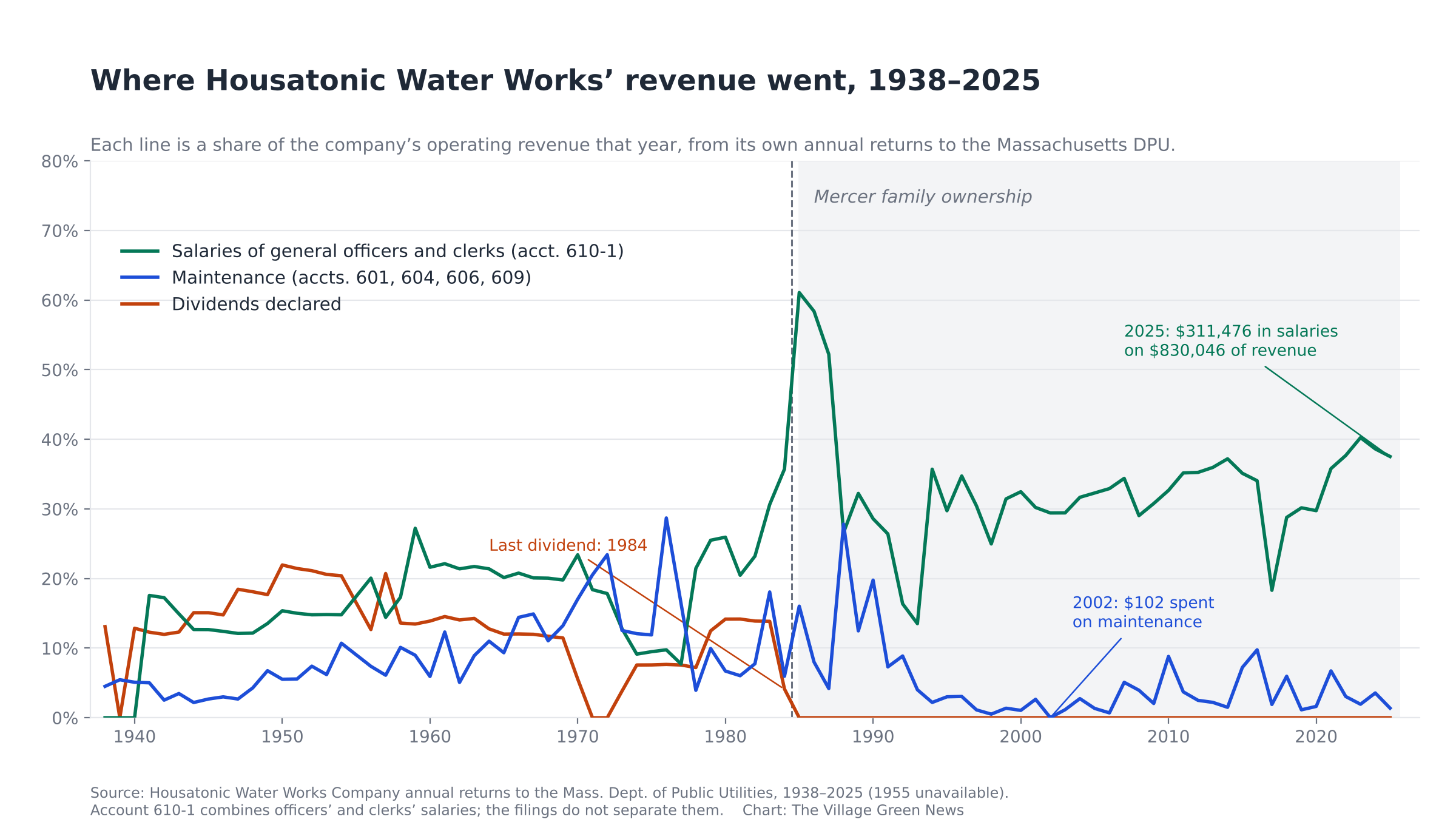
Do the HWW officers pay themselves more than the officers of other comparably small, privately-owned water utilities in Massachusetts?
The contrast is with what other companies spend in maintenance alongside salaries.
Agawam Springs Water Company, a private utility with about 1,100 customers and 13 miles of water mains, is the closest comparison in Massachusetts.
In 2025 Agawam spent $252,569 maintaining its system.
Housatonic, again, spent $11,469.
(You can find every Mass water company’s financials here.)
4) What HWW has spent on Plant (Capital Expenses)
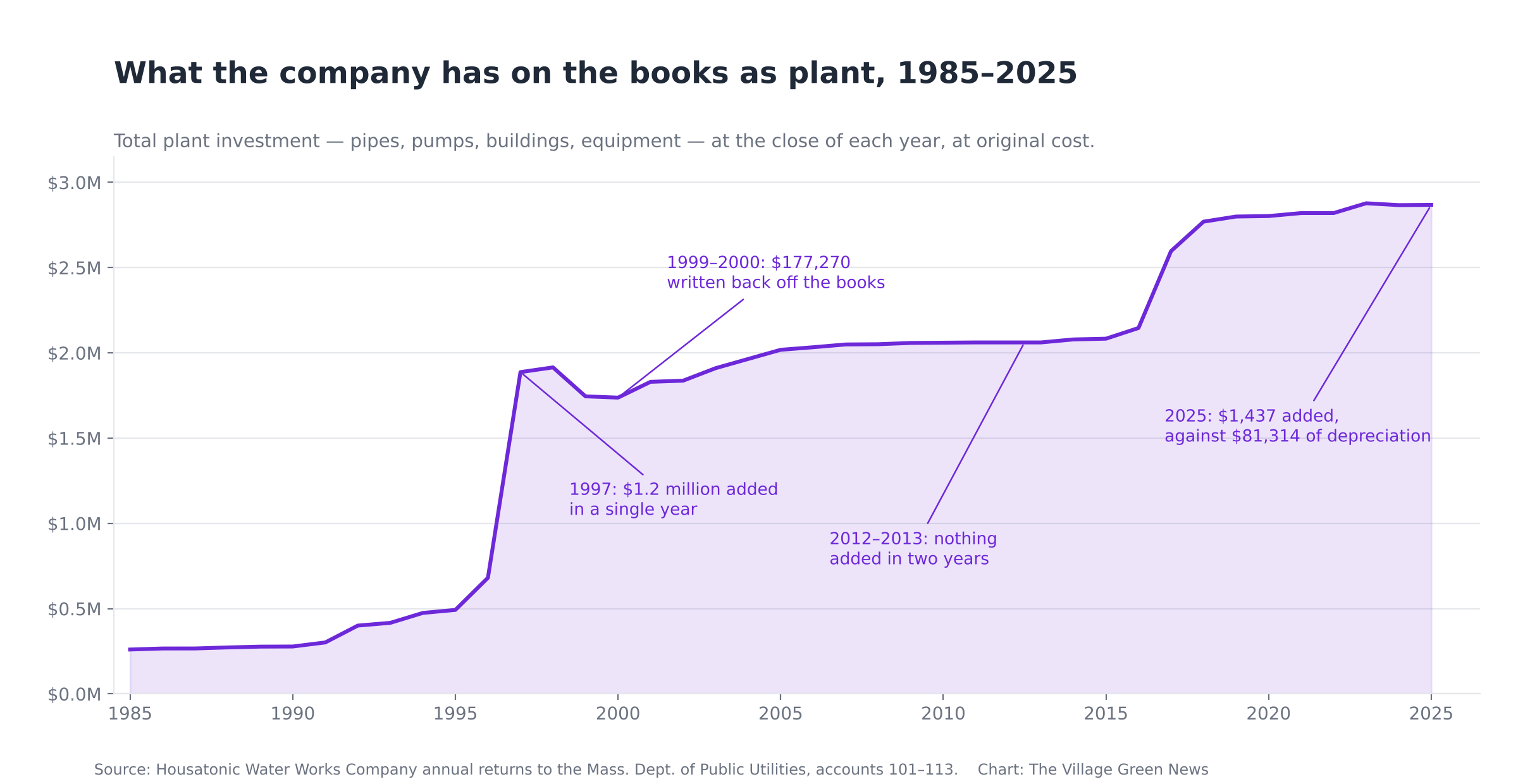
HWW has roughly kept up on plant/capital expenses. Over the forty years the company spent $1.43 for every dollar of depreciation. In 2017 the company laid 2,054 feet of main and paid out in salaries $117,029, the lowest in two decades. The same year they added $199,033 to Account 315.
All told Housatonic Water Works under Mercer management has put about $3.3 million into their water system, with $2.6 million going into capital (plant) building and new equipment, and $678,000 into repairs and maintenance. On top of that the company has also spent $535,381 on a manganese treatment project, $241,477 of it in 2025, but that project, as of the end of September, has now been halted.
5) What HWW has recorded as “Accrued Liabilities,” or IOUs for Officers
In the DPU filings Account 315 has been a mysteriously unexplained, unfunded line item vaguely labeled “Other accrued liabilities.” It’s worth spending some time with Account 315 because it’s a very large IOU.
$2,596,384, to be exact, or nearly $300,000 more than what DPC Engineering has said the whole company is worth.
Account 315 first appeared on the books in 2000 at $3,215 and has built up to the $2.6 figure over the past 26 years.
Peter Most, attorney and member of several Great Barrington town committees, has dug into these same documents and estimated, in his Berkshire Edge piece on HWW’s finances, that the company is actually worth closer to $1.5 million.
Most further surmised that the $2.6 million in Account 315 referred to deferred compensation that the Mercers expected to pay themselves at a future date.
He’s correct.
In response to the Attorney General’s request for clarification about Account 315, HWW responded that the “unpaid compensation” for the officers was back pay for work already done during the years “when cash flow was directed primarily into Company operations rather than payment of the wages that were due.”
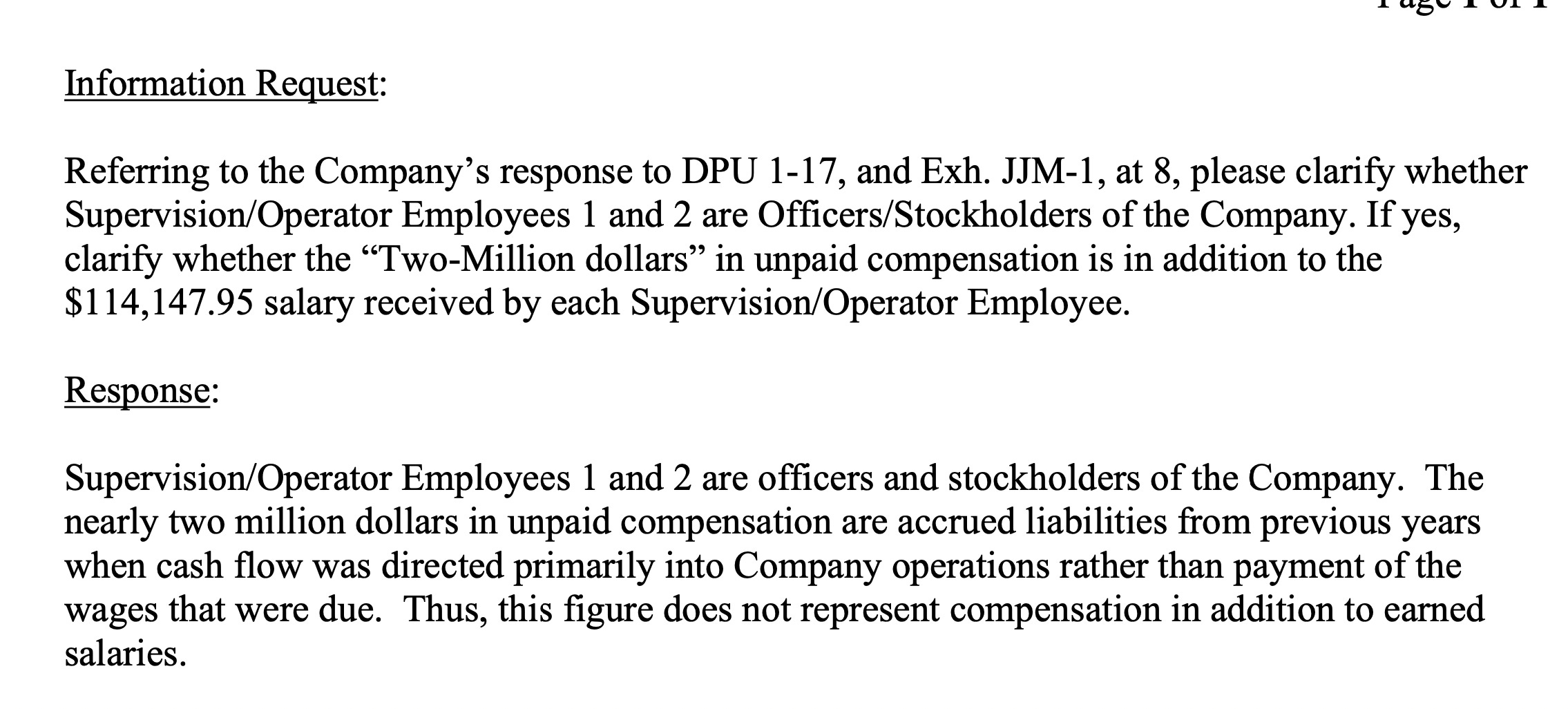
In other words, the Mercers claimed that when they were required to put more into the company they recorded money they should have paid themselves as regular wages but couldn’t afford to, in order to be properly compensated at a future date.
This claim does not stand up under scrutiny.
For the first sixteen years of their ownership, including 1986, 1994, 1996 and 1997, the years with the most pipe work and a $1.2 million capital project, HWW recorded no accrued liabilities in Account 315.
The accrued liability only begins in 2000 and takes off after 2005, when work on replacing the water mains fell to 1/5th of the industry benchmark.
From 2006 onward the company averaged just $22,436 a year in maintenance expenditures, but averaged $123,457 booked into its unpaid compensation/ accrued liability/Account 315.
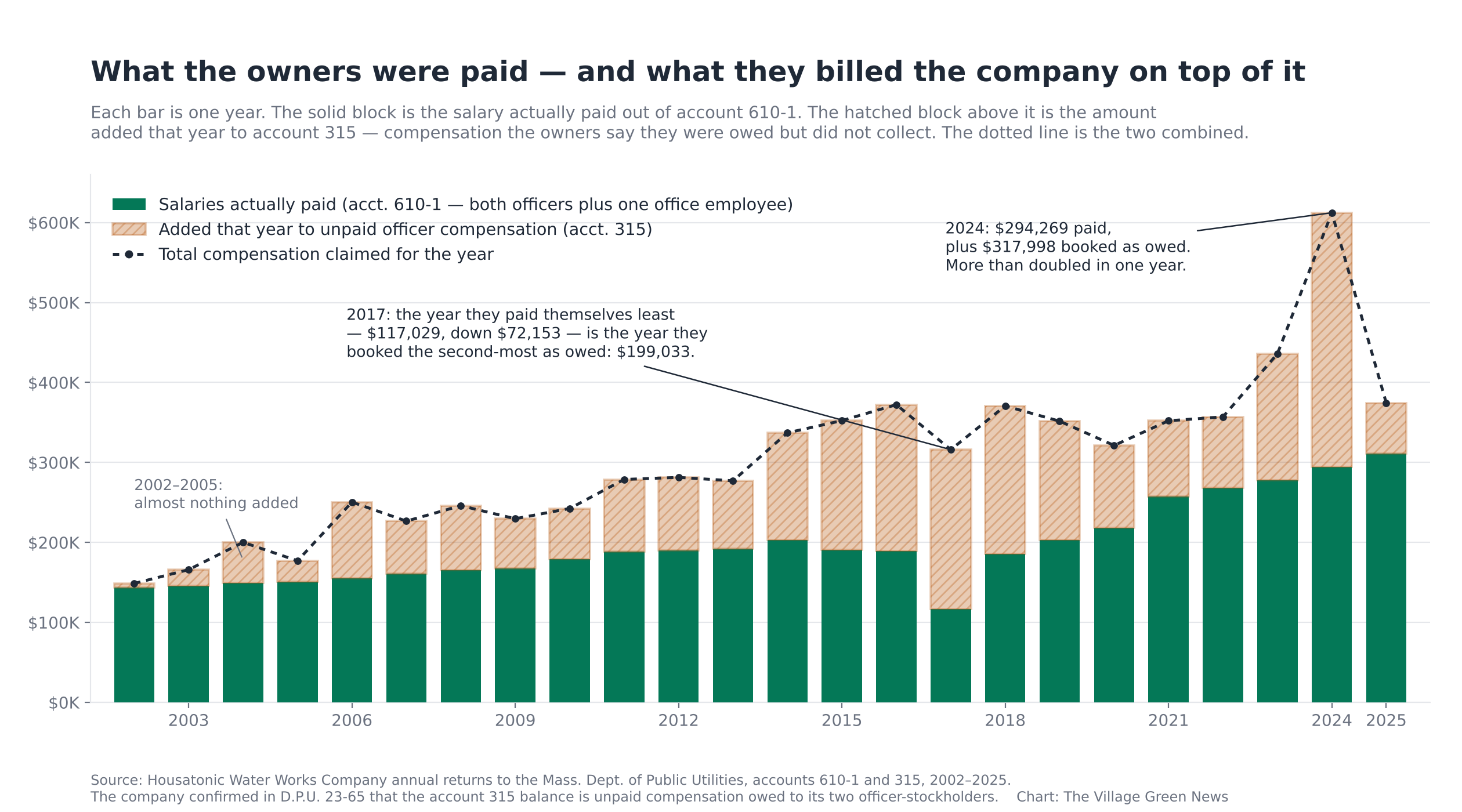
The unpaid compensation figures have apparently not been calculated according to any formula. A real deferred compensation plan would include a definition of benefits or a stated percentage of profits to produce the numbers. HWW’s entries, on the other hand, jump from $88,533 to $317,998 to $62,817 in three consecutive years.
Stay tuned to find out if the full $2.6 million IOU will ever come due.
Stay tuned, also, for an upcoming story on HWW’s “unaccounted water” problem, which will be sent only to paid subscribers.
Become a paid subscriber today to ensure you get access to everything on the Village Green.
Great job and super smart use of AI. 👏
Thank you for this!