

The Big Picture
After several years of strong pandemic-era activity and a subsequent slowdown, South County’s housing market is heading into fall with more sales, higher dollar volume, and modest price growth, even as properties are taking slightly longer to sell.
According to Berkshire REALTORS® MLS data, South Berkshire recorded 89 residential sales in the first half of 2026, up 14% from 78 during the same period last year. Dollar volume rose 24%, from $61.68 million to $76.18 million, while the median sale price increased about 3%, from $605,000 to $625,000. Average days on market increased from 157 to 166. At the end of the reporting period, there were 139 active residential listings and 69 pending sales, with approximately 9.4 months of absorption based on the report’s methodology.
The broader South Berkshire market — including residential, condos, multifamily, land, and commercial properties — was also more active, with transactions up 25% and dollar volume up 26%, to approximately $90.6 million.
Taken together, the numbers don’t suggest a declining market. But they also don’t point to a return of the pandemic-era frenzy.
Corey Bishop, president of the Berkshire County Board of REALTORS® and broker/co-owner of Bishop West Real Estate, describes South Berkshire as “active, but increasingly selective and price-sensitive.”
That selectivity becomes clearer when you break down the numbers by town and, especially, by price range.
South County at a Glance
The South County market report covers nine towns: Alford, Egremont, Great Barrington, Monterey, Mount Washington, New Marlborough, Sandisfield, Sheffield and West Stockbridge.
But with some towns recording only a handful of transactions, town-by-town percentages can be misleading. In Alford, for example, just two homes sold in the first half of both 2025 and 2026, even though the dollar value of those sales increased substantially.
Great Barrington, with considerably more transactions, provides a more useful window into the South County market.
Great Barrington: The Bellwether That Won’t Cooperate
As South County’s hub, Great Barrington serves as a useful proxy for the region, illustrating how difficult it can be to read a small market at face value.
In the first half of 2025, 35 residential properties sold in Great Barrington compared with 25 in the first half of 2026 — a decline of 29%. Dollar volume fell 22%, from $23.14 million to $18.05 million. Yet the median sale price rose 6%, from $560,000 to $595,000.
What’s behind the apparent contradiction?
Bishop said there is “a good variation of mix in the property,” and offered to drill down into the individual transactions to examine what actually sold.
Limited transaction volume, available inventory, property mix, and price point can materially affect the numbers. Ten fewer transactions in a market that recorded only 35 sales in the first half of the previous year produce a 29% decline, but that does not necessarily mean buyer demand or property values fell by anything approaching 29%.
The takeaway isn’t so much that Great Barrington’s market is slumping or thriving. It’s that the numbers need to be read in context.
A More Selective Market
The first-half numbers don’t point to a market-wide frenzy. Instead, they show a market that’s active but increasingly segmented by price, condition, and location.
“There is no standout hot market segment in South Berkshire right now,” Bishop said during a follow-up interview. It’s a notable shift from the market’s pandemic-era peak, when homes routinely sold within days, often over asking and sight unseen, with buyers waiving inspections just to compete. That frenzy has been replaced by something more selective: strong demand for the right properties and a greater willingness among buyers to walk away from the rest. Inventory varies sharply by price point — lean in the entry-level range, and considerably more plentiful as prices climb above $500,000.
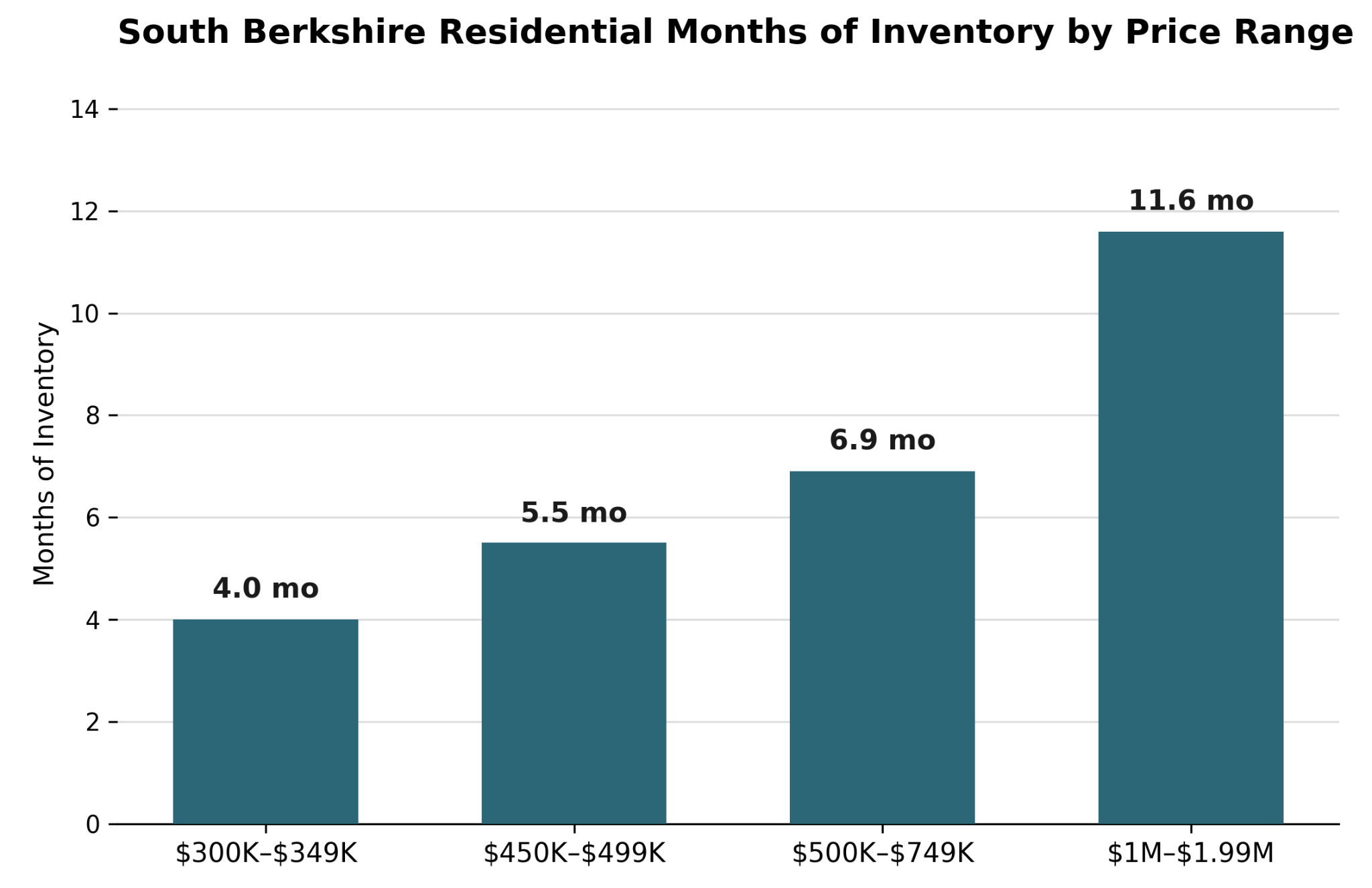
Above $2 million, inventory balloons further still — to roughly 39.6 months, or more than three years’ worth of supply at the current pace of sales.
That spread helps explain why the region’s overall average of 166 days on market — up from 157 a year earlier — can be misleading as a single number. Bishop cautioned against reading it as how long it takes to sell “a typical South County house.” As his report puts it: “A 500,000–750,000 property is essentially sitting in a balanced market, while a $1 million-plus seller is competing against considerably more supply relative to demand. That’s why pricing, condition, and location matter tremendously right now.”
Maureen Kirby-White, a managing partner of Berkshire Hathaway HomeServices Barnbrook Realty, called it “a very healthy market,” noting that “demand remains strong, inventory remains relatively low, and well-priced, appealing properties continue to sell quickly.” She tempered that assessment, however, by noting that once-common multiple-offer bidding wars are no longer happening across the board.
Rachel Louchen, a Compass agent whose work is shaped in particular by full-time, local buyers, sees a shortage not necessarily of listings, but of homes in the condition and price ranges buyers want. “I don’t think there’s a lack of inventory — I think there’s a lack of inventory in the condition and price range people want,” Louchen said. “It’s not that they’re not on the market. It’s that people want turnkey, and turnkey is scarce.”
Bishop makes a similar distinction. “More inventory doesn’t automatically mean better inventory,” he said, adding that buyers are becoming more selective about what they purchase and what they’re willing to spend. “I do think that people are looking for more homes that are, you know, in better condition and are priced properly.”
The Inventory Question
Low inventory has been a running theme of the housing market nationwide for the past several years, and South County is no exception. But whether inventory is increasing depends on the market sector — and on what buyers are looking for.
“Inventory levels are at pre-pandemic levels and, depending on the town, there is enough depth to create real opportunities for buyers,” said Selina Lamb, founder of BIRCH Properties. By her reading, the tight supply has genuinely eased.
Kirby-White described inventory as somewhat improved, “but I would still characterize it as low, particularly when it comes to quality homes in desirable locations,” she said. “We simply do not have an abundance of compelling inventory, and that scarcity continues to support values.”
The Berkshire REALTORS® analysis similarly cautions that more listings don’t necessarily translate into better choices. Countywide inventory had improved to 561 homes, about 7% above the prior year, but remained historically low compared with earlier years. The Market Watch report shows that the county often had more than 1,000 residential listings, and at times more than 1,500, during the previous two decades.
For South County, the issue is also where that inventory is accumulating. The report identifies $500,000-plus as the region’s most heavily supplied segment, even as inventory there moves more slowly.
In other words, buyers may have more listings to look at without necessarily having substantially more of the homes they most want to buy.
The Mortgage Wild Card
No fall outlook is complete without the rate question, especially since it just got more complicated.
On September 16, the Federal Reserve raised its target for the federal funds rate by a quarter point, its first increase since 2023, citing elevated inflation. Mortgage rates, meanwhile, had climbed to roughly 7%, their highest level in about a year. (It’s worth noting that mortgage rates do not move in lockstep with the Fed’s policy rate; they are more closely tied to longer-term bond yields and other market forces.)
Kirby-White said, “Rates matter, particularly to our primary-home buyers, but they are not the sole driver of our market.”
Louchen said the full-time local buyers she typically works with have been relatively unaffected by rate changes. “Everyone I’m working with is taking out a mortgage — nobody’s paying cash. The mindset is: date the rate, marry the house.” Instead, her clients focus on finding the right home, expecting refinancing to be an option down the line if rates eventually fall.
Bishop sees a more segmented effect. South County has a significant cash and second-home component, he noted in his written analysis, so higher rates won’t affect every buyer equally. The rate environment may affect financed and affordability-sensitive buyers more than the upper end of the market or buyers relying on cash and accumulated equity.
During the follow-up interview, Bishop also described another effect of the current rate environment: buyers are reassessing whether moving makes sense at all.
“I would say that they are being more discretionary,” he said. Some are reconsidering whether their current situation is better than taking on a new mortgage at 7% and paying for work on a new property. Others, he said, may renew a lease for another year to see what happens with inventory and the broader market.
That could become an important factor in the fall market: not simply whether buyers can afford to purchase, but whether they decide that moving is worth the cost.
Looking Ahead
The first half of the year was strong, particularly in South County, but the market report also raises questions about whether that pace will continue.
Berkshire County had 113 pending residential sales at the end of the second quarter, down 11% from 127 a year earlier. Bishop said he will be watching pending sales, inventory and absorption by price point, as well as the effect of mortgage rates moving back toward 7%.
The timing of the fall market may also matter. During the follow-up interview, Bishop said the next several weeks are an important window because buyers and sellers are weighing whether a transaction can close before winter.
“Deals are going to happen over the next couple of weeks,” he said. In less-competitive segments, he expects buyers may have “a little bit of the upper hand” in negotiating before the end of the year.
That doesn’t mean every South County buyer will have leverage. Bishop said the $300,000-to-$350,000 range is likely to be the most competitive portion of the local market, while the $450,000-to-$750,000 range can still be competitive depending on condition and whether a property is turnkey.
The bigger question is whether the market’s first-half momentum carries into the fall, or whether higher mortgage rates, more selective buyers, and uneven inventory produce a more pronounced slowdown.
Conclusion
Like so much in real estate (and life!), the market cannot be summed up in a single, tidy forecast.
For sellers, pricing matters more than it did a few years ago, and 2021–22 sales are increasingly beside the point as pricing benchmarks. Buyers have more room to negotiate, though not necessarily for the most desirable, move-in-ready homes, which can still have little to no wiggle room.
Those contrasting dynamics — where sellers still have an advantage and where buyers may have leverage — will be explored in the next two parts of this series.
For now, the bottom line is that South County’s market is neither boom nor bust, but increasingly selective. Sales are up, dollar volume is up, and median prices have edged higher, while average days on market have increased. Inventory has opened up in some sectors, even if much of what is available does not match what buyers most want. And the experience of buying or selling varies considerably by price range, property condition, and location.
As Bishop put it during the follow-up interview, “people are just being a little bit more picky about what they’re buying and what they’re spending their money on.”
The result: an active market, but far more selective than the one South County experienced a few years ago.
Thanks for the report. What's missing here is the fact that so many people here are struggling to afford housing. Many people are homeless. Many people are living in their cars. Even elders are living in cars sometimes. We have people desperately seeking to rent an apartment and saying their maximum price they could possibly pay and then seeing the rental prices significantly above that. We're working all the time to barely get by. I am a carpenter and work all the time and can barely pay the bills let alone save anything or pay down debts faster than required. That's what you miss when you write an article from the point of view of real estate investors, who are not the majority of the people. The median house price of $625,000 is crazy. The people who mow the lawns and build and reonvate the houses and do the tree work are really not doing well here. I am glad to be able to comment here. Many similar places do not allow comments or have strong social pressures to not comment on the elephant in the room, but it is always there.