

THIS DOCUMENT WAS PRODUCED WITH CLAUDE AI WITH A TRANSCRIPT PROVIDED BY CTSB TV, AND HAS BEEN CORRECTED, EDITED AND AUGMENTED.
Corrections may be included in comments below or sent to info@villagegreennews.com.
The Great Barrington Community Preservation Committee (CPC) met Nov. 10 to decide one thing: which applications are eligible for CPA funding.
Chair Karen Smith said several times that this step decides eligibility only, not who gets money. All nine applications were advanced, some with conditions.
Together they ask for roughly $1.72 million. Smith displayed a chart showing $981,000 in historic-preservation requests, $63,000 in open space and recreation, and the Affordable Housing Trust’s $675,000. Staff were asked how much money is available, but the answer isn’t in the transcript.
The night began with bad news about the committee itself.
The committee is down three seats
Smith announced that Vice Chair Kate Van Olst has resigned from the Conservation Commission, which means she also leaves the CPC. Van Olst is also the town’s conservation agent, and Smith said separating that staff job from her board roles was “the best thing” for the committee’s integrity. She added that she learned of the resignation that afternoon. James Mercer has also resigned. The Historical Commission will appoint his replacement, and the town manager will contact both boards.
Smith then publicly criticized the Finance Committee for declining to fill its vacant seat because the job was too much work. She said it amounts to about eight weeks a year and six or seven meetings, and told them to “get over yourselves.” The committee now has six of its nine seats filled, and later that evening it deadlocked on a vote.
During public comment, James Garzon (online) defended the Finance Committee. He said its members discussed the appointment at length and honestly did not have the bandwidth, and that residents are already stretched thin.
The committee also chose a new vice chair.
Ramsdell Library: $500,000 advances, with demolition questions unresolved [54:06]
Laura Mars presented a $500,000 request. If the state Massachusetts Board of Library Commissioners (MBLC) grant comes through and town meeting approves the full project, the money would offset the town’s share. If not, it would pay for an accessible bathroom and possibly new windows.
Smith warned that money approved for one purpose can’t be moved to another once town meeting votes. Ramsdell will go to a separate town meeting, date not yet set.
Martha Fick read aloud a Massachusetts Historical Commission (MHC) letter addressed to Ruby Chang. It found the project would have an “adverse effect” because it demolishes the 1930 addition, which was built during the library’s 1906–1964 period of significance. Fick said demolishing it was “not preservation, it’s destruction.”
Christopher Rembold said any historic-preservation project must meet the Secretary of the Interior’s Standards, and CPA money cannot pay for demolishing a historic asset.
Lauren Clark, Vice Chair of Library Trustees, said their current MHC contact has written that the addition is “not necessarily a stumbling block” and that Chang is no longer involved.
On Nov. 18, the Select Board, the library trustees and the Historical Commission will meet. A memorandum of agreement must be signed by year’s end for the library to stay eligible for the grant.
Speaking for herself, not the committee, Smith suggested the trustees ask for the bathroom alone, since it has to be made accessible whatever happens to the building. Another member added that the project “has been on the docket for a decade.”
Vote: advanced unanimously.
The tie: historic design guidelines [32:29]
The Historic District Commission asked for about $25,000 to replace its 20-year-old design guidelines. They were written in-house, based on the guidelines of Concord and Somerville. Modern professionally written versions run more than 150 pages. The commission’s presenter, Donald Howe, said the MHC staff contacts who would normally advise on this have left and haven’t been replaced.
Staff went through the Community Preservation Coalition’s eligibility checklist. The guidelines are not a building, structure, property, document or artifact, so eligibility is doubtful. Staff also noted that several other Massachusetts towns have used CPA money for similar guidelines. Smith said, “I do not see how this meets the guidelines.”
First motion (eligible): failed on a 3–3 tie.
Second motion (eligible pending town counsel advice): passed, one opposed.
Black history walking trail: category debate [19:12]
The Du Bois Freedom Center asked for $28,000 for informational kiosks on town land along sidewalks. The kiosks would cover sites linked to W.E.B. Du Bois, the historic Black community on Rosseter Street, Elm Street and Elm Court, Clinton A.M.E. Church, and a former Green Book lodging. The sites were chosen with help from the Department of Public Works.
Marcus P. Smith, Deputy Director of the Center, said the trail could count as historic preservation only if every site is on the state register or the Historical Commission votes each one significant. Smith pointed to the imbalance between the historic and recreation categories and called site-by-site votes a waste of time.
Vote: the first motion, for both categories, was withdrawn. The committee then found the trail eligible under open space and recreation, with no one opposed.
Other requests that cleared Step One
Affordable Housing Trust, $675,000 [2:51]. The money would go to emergency rental assistance, 0% down-payment loans, ADUs, affordable housing development and property acquisition. The trust is considering saving this year’s $150,000 for development and combining it with the next two years’ money. It would then issue a request for proposals for a developer around July 1, possibly for a ballfield site, modeled on the Housatonic School process. Smith noted the application checked four CPA categories, more than in past years. Unanimous.
Berkshire Natural Resources Council, $25,000 [9:08]. This would pay for an accessible 18×20-foot pavilion on property on Blue Hill Road. The building has to be up before MassWildlife records a conservation restriction on the land, possibly by June 30, or it won’t be allowed. Because CPA money normally arrives July 1, staff will ask counsel whether town meeting can fund it from reserves right away. Passed.
Town trail signage, $10,000 [17:02]. The money would be the town’s 25% match for a MassTrails grant of $40,000–$50,000, in partnership with the Berkshire Regional Planning Commission. Unanimous.
St. James Place, $116,850 [30:00]. The money would remove a crumbling chimney to protect the bell tower. The total cost is about $130,000, with 10% raised privately. Steve Bannon recalled that the building once nearly became a parking lot. Passed.
Tunnel kiosk/shelter, $120,000 [44:37]. The money would repair the wooden shelter, now covered in graffiti, and add a center handrail required under the ADA. CPA already paid for the design. Unanimous.
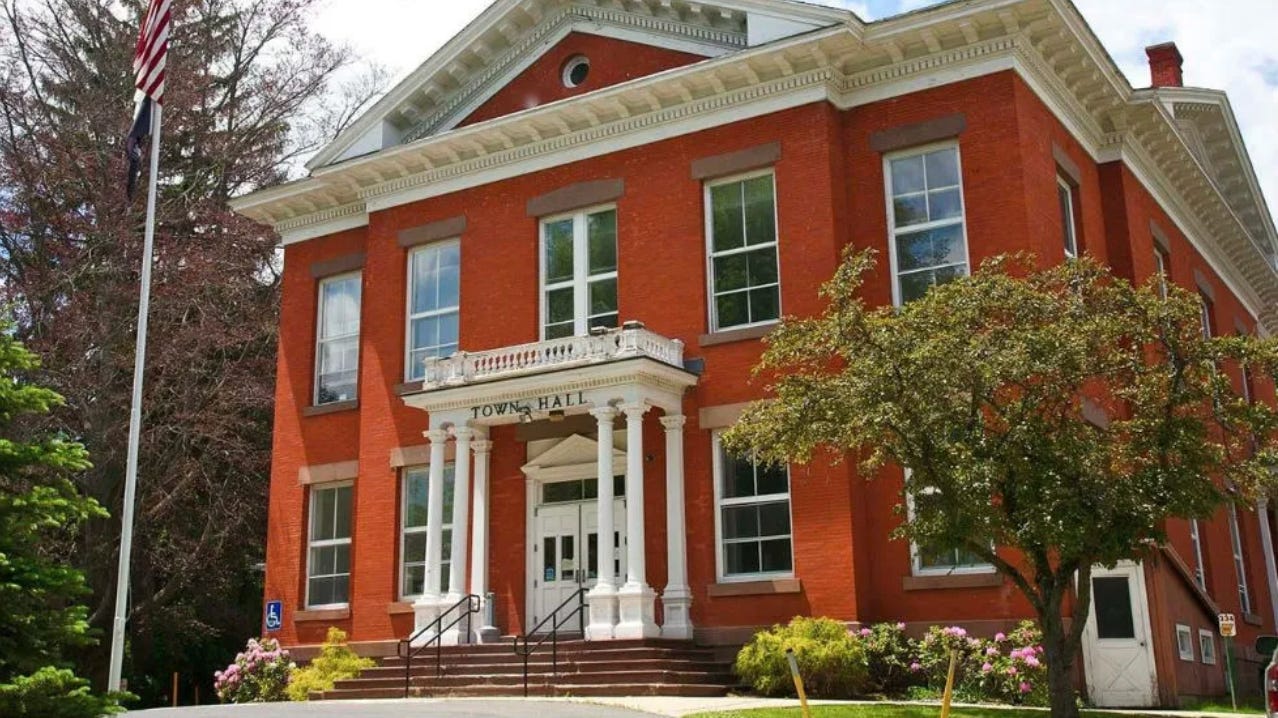
Town Hall exterior, Phase 1, $200,000 [47:21]. This is based on a water-infiltration report that found about $151,000 in immediate needs, plus a 30% contingency.
Phase 2 is estimated at $739,000 and Phase 3 at about $978,000. Passed, none opposed.
Du Bois artifacts display at Town Hall [50:13]. A resident has a large Du Bois collection to donate or lend. The money would pay for display cases and a conservator to curate them. The amount wasn’t stated, but Smith’s chart implies about $19,000. Unanimous, conditional on the Historical Commission voting that the artifacts are significant.
Public comment
James Garzon supported the Affordable Housing Trust’s request. He also worried that high taxes, utilities and upkeep could set new affordable homeowners “up for failure.”
Next steps
Nov. 18: Ramsdell meeting with the Select Board, trustees and Historical Commission
Step Two applications are due Dec. 11. Reviews are scheduled for Dec. 15 and Jan. 5–6, with the final vote Jan. 7. (These dates are from the September CPC meeting and weren’t confirmed in this transcript.)
Town counsel will advise on the design guidelines and on the pavilion’s timing
The Historical Commission will vote on the artifacts
The Historical Commission and the Finance Committee still need to appoint members